



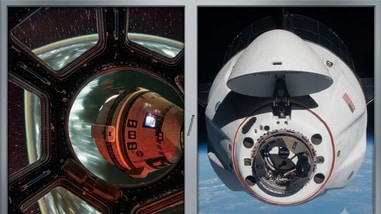
Boeing’s Starliner spacecraft is expected to make a comeback on the launchpad by the end of this year or by January 2027, NASA revealed in its plan on September 28.
Starliner, manufactured by Boeing, is the same spacecraft that left astronaut Sunita Williams and Butch Wilmore ‘stranded’ in space for about nine months.
Providing an update on the Starliner spacecraft, NASA Administrator Jared Isaacman said, “We have worked closely with Boeing to address the issues identified on previous Starliner flights, and we intend to see this vehicle return to flight in support of the International Space Station and future commercial destinations.”
NASA will first plan an uncrewed Starliner-1 mission to the International Space Station “to validate the improvements made to the spacecraft and gather the flight data we need,” said Isaacman.
The uncrewed Starliner-1 has the potential to fly in December of this year or January 2027.
The space agency will use data to learn and implement the corrective actions and complete the testing and certification required for crewed flight.
“Starliner’s next flight [after uncrewed mission] is a critical step on the path to achieving full system certification and ensuring a sustained human presence in low Earth orbit,” said Dana Weigel, manager of NASA’s Low Earth Orbit Program.
NASA currently plans to return astronauts on Starliner-2 by 2028, the NASA chief said.
Ultimately, NASA expects to fly as many as five crewed missions for Starliner to the ISS, Administrator Jared Isaacman told reporters on Monday.
The decision came nearly a year after NASA opted to cut the number of Starliner missions from six to four. That move followed a botched test flight of Starliner that led to two astronauts staying nine months in space longer than planned.
After much delay, Boeing’s Starliner spacecraft was launched on June 5, 2024, sending astronauts Butch Wilmore and Suni Williams into space. They reached the ISS on June 6. It was Starliner’s first crewed flight.
Now, what was supposed to be an eight-day mission turned into a nine-month-long space saga.
During its flight, faced technical difficulties during docking with the International Space Station (ISS). The anomalies included thruster failures, helium leaks, and issues with the propulsion system.
NASA had determined it was too much of a risk to put the two NASA astronauts back on board Starliner, and changed its ISS manifest to bring the astronauts home in another way.
returned empty in September 2024, while its riders — — returned safely to Earth aboard SpaceX’s Dragon spacecraft in March 2025.
In February this year, NASA released findings from the agency’s Program Investigation Team outlining the programmatic and technical issues resulting in an uncrewed return of the Starliner during its first crewed flight in 2024.
In total, the investigation identified 61 recommendations to NASA to ensure that future missions meet the high standards required for human spaceflight.
“Investigators identified an interplay of combined hardware failures, qualification gaps, leadership missteps, and cultural breakdowns that created risk conditions inconsistent with NASA’s human spaceflight safety standards…” a said.
The US currently has only one American spacecraft, which it uses for commercial crew space missions — taking humans to and from ISS. It’s SpaceX Crew Dragon spacecraft.
Even if SpaceX’s Dragon can successfully transport astronauts to the ISS, the agency needs a backup.
In such a scenario, the availability of Boeing’s Starliner spacecraft would hold significance as it would provide a vital backup system for carrying American astronauts to space.
Having a second commercial crew vehicle provider would simply mean that NASA will not have to depend on one company or vehicle for space launches as it previously had to.
On Monday, NASA Administrator Jared Isaacman highlighted that “there will be growing demand for launch vehicles, transfer stages, landers, and, of course, spacecraft that carry astronauts.”
Isaacman said that NASA has been committed to having multiple crew transportation options since the beginning of the Commercial Crew Program. His statement came as America hopes to build a Moon base and explore Mars in the future.
If Starliner proves successful in its upcoming space mission, it may be able to compete with SpaceX.
In 2014, NASA awarded a Commercial Crew Transportation Capability contract to Boeing to fly astronauts to and from the International Space Station with its Starliner spacecraft.
Notably, NASA still uses the Russian Soyuz spacecraft to take cosmonauts and astronauts to and from the space station.
NASA says, “The is like a lifeboat. At least one Soyuz is always attached to the space station. If there were an emergency on the space station, the crew could use the Soyuz to leave the space station and return to Earth.”
Read:
Besides, Blue Origin is also working with NASA in this latest round of commercial crew contracts and developing a lunar lander for the Artemis program.
“The company’s Blue Moon Mark 1 Endurance lander will deliver NASA payloads to the lunar South Pole’s Shackleton Connecting Ridge, demonstrating capabilities that reduce risk for astronauts to land on the Moon during Artemis…,” NASA said in its June 24 statement.
NASA recently added Blue Origin’s New Glenn 9×4 launch service to the NASA Launch Services (NLS) II contract.