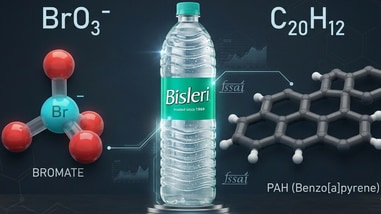
The Food Safety and Standards Authority of India (FSSAI) has sanctioned prosecution against packaged drinking water manufacturer Bisleri International after one of its water samples was declared “unsafe” in laboratory testing. The company, however, has disputed the findings, triggering a row over the presence of bromate and polynuclear aromatic hydrocarbons (PAHs) in the sample.
According to the World Health Organisation (WHO), prolonged exposure to certain chemical contaminants in drinking water, including bromate and some PAHs, may pose health risks, including potential kidney damage and an increased risk of cancer.
The two substances have different sources and potential health effects.
Bromate is a chemical compound that can form during drinking-water disinfection, particularly when ozone reacts with naturally occurring bromide ions in water, according to the .
The WHO has set a provisional guideline value of 10 micrograms per litre (µg/l) for bromate in drinking water, primarily because of concerns about its potential carcinogenic effects.
The International Agency for Research on Cancer (IARC) has classified bromate as a Group 2B substance, meaning it is “possibly carcinogenic to humans”. According to the WHO, while evidence of carcinogenicity in humans is inadequate, animal studies have shown sufficient evidence of cancer-causing potential.
Bromate has also demonstrated mutagenic properties in laboratory studies, meaning it can cause changes in genetic material, or DNA. The WHO’s assessment discusses oxidative DNA damage as one possible mechanism behind its carcinogenic effects.
Animal studies have linked prolonged exposure to bromate with tumours in the kidneys and thyroid, among other tissues. These findings raise concerns about long-term exposure, although they do not mean that consuming water with a slightly elevated bromate concentration will immediately cause cancer.
The potential health risk depends on the concentration consumed, the frequency of exposure and its duration. The WHO’s guideline is intended to limit long-term exposure and reduce associated health risks.
Polynuclear aromatic hydrocarbons, commonly called PAHs, are a group of organic chemical compounds containing two or more fused aromatic rings.
According to the WHO, PAHs are formed primarily through the incomplete combustion of organic materials. They can enter the environment through industrial emissions, vehicle exhaust and other sources of atmospheric pollution. They may also contaminate drinking water through coal-tar coatings used in water distribution pipes.
PAHs can enter the human body through food, air and drinking water. The WHO notes that these compounds may be present in food following exposure to airborne pollution and in fish from contaminated waters. They can also form during cooking methods such as grilling, roasting, frying and baking.
Some PAHs are particularly concerning because of their carcinogenic potential. The WHO identifies benzo[a]pyrene as an important indicator of PAH contamination and has prescribed a guideline value of 0.7 micrograms per litre in drinking water.
The WHO’s assessment says evidence linking PAH mixtures to cancer in humans comes primarily from occupational studies involving inhalation and skin exposure. It also notes that human data on cancer risks from oral exposure are unavailable.
The health effects vary depending on the specific PAH, the amount of exposure and its duration. Prolonged exposure to certain compounds, particularly benzo[a]pyrene, is a concern because of their cancer-causing potential.
The dispute relates to a sample collected by froms Goa manufacturing facility on September 30, 2025.
According to the company, the regulator collected six samples, of which five initially met the applicable standards. The sixth recorded bromate at 12 micrograms per litre, against the prescribed limit of 10 micrograms per litre, it mentioned, as per PTI.
Following Bisleri’s appeal dated November 22, 2025, FSSAI sent the sample to a referral laboratory for retesting. The company said the laboratory found bromate within the prescribed limit but separately flagged the presence of PAHs.
Bisleri subsequently arranged an independent test at an FSSAI-approved laboratory, which also found bromate within the prescribed limit, it said. The company submitted the results to FSSAI’s Western Regional Office through a formal letter dated February 2 this year.
Bisleri said it received no further communication from FSSAI and understood the matter to be closed. It also maintained that it had not received any formal notice by email or in hard copy.
However, FSSAI announced on Sunday, November 22, that it had sanctioned prosecution against Bisleri International Pvt Ltd after finding its packaged drinking water sample “unsafe”.
In its statement on Monday, Bisleri said it would cooperate with the regulator to address the issue and reiterated that its packaged drinking water was safe for consumption.
“Drinking water safety is a priority for Bisleri. We maintain stringent quality controls of over 90 tests across our 10-step manufacturing process,” the company said.