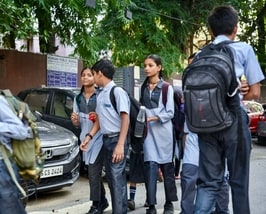
The Delhi government has directed schools across the national capital to introduce measures to combat air pollution during the winter months, including improving classroom ventilation, sprinkling water to control dust and encouraging students to use public transport.
Under the Winter Action Plan 2026–27, all government, government-aided and private unaided recognised schools have been asked to implement pollution-control measures from October 2026 to February 2027.
A circular issued by the Directorate of Education (DoE) on October 29 outlines the steps schools must take to reduce pollution within their premises and limit students’ exposure to toxic air.
The measures include avoiding dust-generating construction activities, expanding green spaces, promoting recycling and implementing the Graded Response Action Plan (GRAP), Hindustan Times reported.
According to the DoE circular, school heads have been instructed to take several steps to improve air quality within their campuses.
These include regularly sprinkling water in open areas to control dust, increasing green patches and installing proper and efficient ventilation systems to ensure clean air inside school buildings.
Schools have also been asked to encourage students and staff to use public transport to reduce vehicular emissions. Promoting carpooling, recycling and reuse, and switching off lights when not in use are among the other measures.
The Directorate has further instructed schools to avoid construction activities that generate dust and implement applicable measures to control air pollution.
The government’s proposed measures also include the phase-wise installation of air purifiers, beginning with 10,000 classrooms in government schools.
The Action Plan also focuses on educating students about the environmental and health consequences of pollution.
Between October and November, schools will organise anti-firecracker campaigns through classroom discussions, lectures, awareness drives and slogan-writing competitions to discourage students from bursting firecrackers.
In November, schools will conduct dedicated air pollution awareness programmes, including poster-making and essay-writing competitions, quizzes and lectures on the role of students in protecting the environment.
Other activities include awareness campaigns on dust and noise pollution and programmes promoting clean and green school environments.
Schools have also been instructed to prevent the open burning of biomass and municipal solid waste within their premises. To facilitate this, the Directorate has asked schools to provide electric heaters to sanitation, security and horticulture staff during winter.
Several schools have started taking steps to comply with the government’s instructions.
Jyoti Arora, principal of Mount Abu School, told PTI that the school had issued directions to parents and students while introducing measures to improve conditions on campus.
She added that students were also being advised against bursting firecrackers.
Tania Joshi, principal of South Delhi’s The Indian School, said that the school was considering installing air purifiers in classrooms, as per PTI.
School heads have also shared suggestions with parents to promote responsible commuting, including carpooling and the use of school buses and public transport.
Delhi experiences a deterioration in air quality during winter, when vehicular emissions, construction dust, industrial pollution and weather conditions contribute to higher levels.
Children are particularly vulnerable to the effects of poor air quality, making schools an important setting for measures aimed at reducing exposure to harmful pollutants.
The Winter Action Plan seeks to involve schools, students, parents and staff in pollution-control efforts, alongside government measures to tackle the city’s air quality crisis.
The Directorate has also introduced a monitoring mechanism to track the implementation of the Winter Action Plan.
School heads have been directed to submit monthly progress reports through a designated by the last day of every month.
The DoE has also called for greater public participation in pollution-control efforts through parent-teacher meetings and School Management Committee meetings, encouraging families and local communities to adopt environmentally responsible practices.
With inputs from PTI.