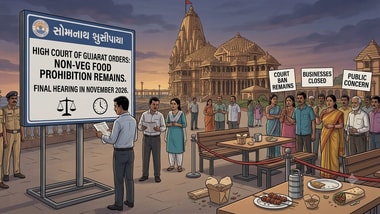
The Gujarat High Court on Friday (October 30) stayed a single-judge order that had struck down restrictions on the sale of non-vegetarian food near the famous .
A division bench comprising Chief Justice Manash Ranjan Pathak and Justice Nirzar Desai passed the order following an urgent appeal filed by the Gujarat government. It directed that the notification issued by the Gir Somnath district Collector prohibiting non-vegetarian food sales in designated areas would remain in force for now.
The division bench will hear the matter next on December 26.
Earlier on Friday, Justice Nisha Thakore had allowed petitions filed by hotel and restaurant owners operating near the in Gir Somnath district and set aside the Collector’s notification.
The state government subsequently challenged the single judge’s decision before the division bench, which stayed its operation late in the evening.
The Collector’s notification, dated August 10, 2026, prohibits the preparation, storage and sale of non-vegetarian food within a 500-metre radius of the Somnath temple.
The restrictions also cover six specifically identified roads connecting important religious destinations in the area that form part of the Somnath pilgrimage circuit.
With the division bench staying the single judge’s order, these restrictions will continue to apply until further directions from the court.
Hotel and restaurant owners had approached the , arguing that the restrictions violated their fundamental right to carry on a lawful business and earn their livelihood.
They challenged the Collector’s notification, which imposed restrictions on the preparation, storage and sale of non-vegetarian food in areas around the temple and along designated pilgrimage routes.
Opposing the hotel and restaurant owners’ petitions, the state government argued that the constitutional freedom to conduct business did not give individuals the right to carry out every form of commercial activity at every location, irrespective of its religious, historical and cultural significance.
The government submitted that Somnath was not an ordinary commercial town, but a place of extraordinary spiritual importance for millions of Hindus.
On this basis, the state defended the restrictions imposed through the Collector’s notification.
The division bench’s stay means the dispute over the legality of the restrictions will continue, with the matter scheduled to come up for hearing on December 26.
(With PTI inputs)