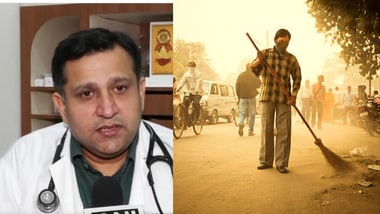
The national capital on Monday recorded an Air Quality Index (AQI) of 312, considered ‘very poor’ for the first time this season. The minimum temperature at the Safdarjung weather station settled at 16.4 degrees Celsius, 1.1 notches above normal. In an interview with news agency ANI, Dr Nikhil Modi of Apollo Hospital advised people with chronic conditions to take precautions in advance to avoid complications. He suggested taking medicines regularly and seeking a doctor’s advice immediately if they feel their health is deteriorating.
While talking about the risks poses to our lungs and other organs, the doctor suggested that people with respiratory problems avoid going out during periods of excessive pollution, especially early in the morning and at night, and use masks. It has been repeatedly suggested that N95 masks are a good tool to combat air pollution.
Invest in air-purifying plants such as aloe vera, ivy and spider plants that can be placed at home and on your office desk. These plants not only purify the air but also calm your mind.
Following a healthy diet rich in antioxidants, protein and green vegetables is vital, as it helps protect your body from the harmful effects of air pollutants.
Dr Modi’s advice came in the wake of a recent surge in patients reporting lung diseases.
“…Since yesterday we are seeing a lot of polluted air around us, which is very harmful for our patients. We already are seeing that those patients who already have lung disease are turning up in our OPD as well as our emergency with increased breathing difficulty, and some of them are even requiring admission. A number of cases are coming with chest infections also…,” Modi said.
The minimum temperatures at other weather stations were recorded at 16.4 degrees Celsius at Palam, 16.8 degrees at Lodhi Road, 17.2 degrees at the Ridge and 16.7 degrees at Ayanagar, according to the India Meteorological Department (IMD).
No rainfall was recorded at any of the five weather stations during the 24 hours ending at 8.30 am on Monday.
The AQI reading of 312 is the morning reading and not the day’s average, which will be available at 4 pm, according to the Central Pollution Control Board (CPCB).
Graded Response Action Plan (GRAP) Stage 2 is applied in Delhi when the Air Quality Index (AQI) enters the ‘Very Poor’ category, ranging between 301 and 400.
The Sub-Committee for Operationalisation of the GRAP, i.e. the Commission for Air Quality Management (CAQM), decides to invoke Stage 2 based on dynamic air quality and meteorological forecasts. It includes strict measures to curb air pollution.