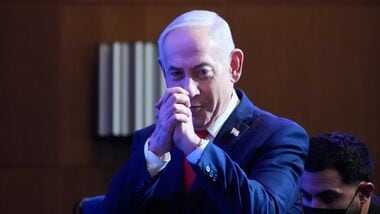
An updated Israel Election Exit poll revealed a dramatic reversal in trends. Israel Prime Minister Benjamin Netanyahu’s coalition, which was trailing by a few points earlier, took the lead over the Opposition bloc with 52 seats. However, the exit polls showed no clear path to a majority for either coalition.
Exit polls projected pro- and anti-Netanyahu blocs neck-and-neck, with the two Arab parties holding the balance. Neither bloc is projected to win a 61-seat Knesset majority.
A party or a coalition needs to win at least 62 of 120 seats in Knesset to form a majority government in Israel. Here’s what different exit polls revealed:
In its updated exit poll, Channel 12 gave the pro-Netanyahu bloc 52 seats and the anti-Netanyahu bloc 49, compared with 50 and 52 in its previous poll, The Times of Israel reported.
The predominantly Arab Joint List and Ra’am parties held the other 19 seats.
What changed from previous exit poll results?
Channel 12 exit polls: Yashar 21 (from 22), Likud 27 (from 24), Yisrael Beytenu 7 (from 8), Joint List 12 (from 11), Shas 7 (from 8), The Democrats 9 (from 10).
Meanwhile, Kan 11, in its updated exit poll, gave the pro-Netanyahu bloc and anti-Netanyahu bloc 51 seats each, compared with 50 and 52 in its previous poll at 11:04 p.m.
What changed from previous exit poll results?
Kan 11: Likud 27 (from 25), The Democrats 9 (from 10), Otzma Yehudit 6 (from 7).
Pollster Direct Polls projected 55 seats for the Netanyahu bloc , 49 for the Gadi Eisenkot-led opposition bloc and 16 for the Arab parties.
Another poll from agency Filber and presented by the pro-government Channel 14 projected 60 seats for the Netanyahu bloc, 43 for the opposition and 17 for the Arab parties.
According to Channel 14, opposition Zionist parties opposed to Netanyahu have 43 seats between them, while the majority Arab parties hold the remaining 17 seats.
Netanyahu’s Likud emerged as the biggest party with a lead on 27 seats, as per the Channel 12 exit poll. It was followed by Yashar with21 seats, B’Yachad and Joint List with 12 seats each.
Voting in October 27 Israel elections, the first since the Hamas attack that led to the Gaza war on October 2, 2023, saw near-final election turnout at 77.7 per cent, the highest since 1999.
Yashar chairman Gadi Eisenkot reportedly called on Netanyahu to “accept the people’s vote of no confidence” and leave political life, adding that “with turnout this high, holding another election would be a mistake.”
“I will do everything in my power to form a Zionist government that serves all,” he was quoted by the Times of Israel as saying.
He described the envisioned coalition as committed to “universal military service” and “dismantling Hamas,” and says it must “respect and see all parts of society.”
Israel Elections: Key political parties in the race:
There are to form government in the country.
The first is the pro-Netanyahu coalition, led by Prime Minister Benjamin Netanyahu’s Likud party and joined by several far-right and ultra-Orthodox parties.
These include United Torah Judaism (UTJ) and Shas – both conservative religious parties – and Otzma Yehudi and Religious Zionism-Zehut, led respectively by far-right ministers Itamar Ben-Gvir and Bezalel Smotrich.
The main opposition coalition comprises four Jewish-led opposition movements: the Yashar party, the Democrats, The Yisrael Beiteinu party and the Together alliance.
The general election, the first to be held since the Hamas-led massacre of October 7, 2023, unfolded amid deep national divisions over security accountability, state leadership and the independence of Israel’s democratic institutions.
Prime Minister Netanyahu, who has remained at the centre of power for 19 years, faced a formidable challenge from former IDF Chief of Staff Gadi Eisenkot and his Yashar Party, which led in various opinion surveys ahead of the vote.