



Alfred Nobel, the Swedish inventor, engineer and industrialist, signed his famous will on November 27, 1895, a year before his death. In it, he stipulated that the majority of his fortune should be used to create a fund whose returns would finance prizes for people who had conferred the “greatest benefit to humankind”.
Nobel directed that more than SEK 31 million of his estate should be converted into a fund and invested in “safe securities”. The income generated from those investments would be distributed annually as prizes.
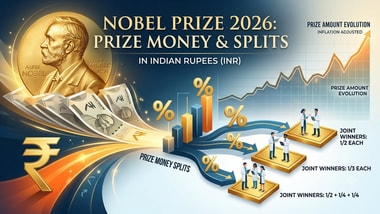
The 2026 Nobel Prize winners will receive SEK 12 million for each full Nobel Prize, marking an increase of SEK 1 million from last year. At an exchange rate of roughly ₹9.60 per Swedish krona on October 6, 2026, the 2026 prize money works out to about ₹11.52 crore per prize.
The increase comes as the Nobel Foundation marks the 125th anniversary of the first Nobel Prizes, which were first awarded in 1901.
The Nobel Prize is awarded in six categories — Physics, Chemistry, Physiology or Medicine, Literature, Peace and Economic Sciences.
So, in simple terms, a laureate who receives an entire 2026 Nobel Prize gets SEK 12 million, or roughly ₹11.5 crore before any applicable taxes or other deductions.
When the first Nobel Prizes were awarded in 1901, each prize was worth SEK 150,782. Alfred Nobel had stipulated in his will that most of his fortune should be invested and the returns used to fund the prizes.
The nominal prize amount changed considerably over the following decades.
By 2000, the award had risen to SEK 9 million, and in 2001 it was increased to SEK 10 million. It remained at SEK 10 million for more than a decade.
The Foundation subsequently reduced the prize to SEK 8 million in 2012, as part of a broader effort to strengthen its finances. It later began increasing the amount again.
The major recent milestones were:
2012: SEK 8 million
2017: SEK 9 million
2020: SEK 10 million
2023: SEK 11 million
2025: SEK 11 million
2026: SEK 12 million
1901 real value today: ≈ ₹10.3 crore.
Lowest real value (late 1910s): ≈ ₹2.9 crore.
1991 restoration: ≈ ₹10.4 crore.
Peak real value (early 2000s): ≈ ₹14–15 crore.
2025 prize: 11 million SEK ≈ ₹10.5 crore.
2026 prize: 12 million SEK ≈ ₹11.4 crore (at the same conversion).
A Nobel Prize can be shared by up to three laureates. The prize money does not automatically mean that every winner receives one-third.
The Nobel Foundation’s rules allow a prize to be divided between two works or shared by two or three people. No Nobel prize can be divided among more than three people.
In practice, there are several possibilities:
One winner
If a prize goes to one person, that laureate receives the entire SEK 12 million.
That would be approximately ₹11.52 crore at the current exchange rate.
Two winners
If two laureates share the entire prize equally, each would receive SEK 6 million, or approximately ₹5.76 crore.
Three winners
If three laureates share the prize equally, each would receive SEK 4 million, or approximately ₹3.84 crore.
However, the prize can also be structured differently when the Nobel committee recognises separate contributions.
For example, in the 2024 Nobel Chemistry Prize, David Baker received half of the prize, while Demis Hassabis and John Jumper jointly received the other half. That meant Baker received one-half, while Hassabis and Jumper received one-quarter each.
The same structure was used for the 2025 Economic Sciences Prize: Joel Mokyr received half, while Philippe Aghion and Peter Howitt jointly received the other half.
ze money is only part of the Nobel award
The cash award is one component of the Nobel Prize. Laureates also receive a Nobel medal and a personal diploma. The prize is formally presented during the Nobel ceremonies on December 10, the anniversary of Alfred Nobel’s death.