



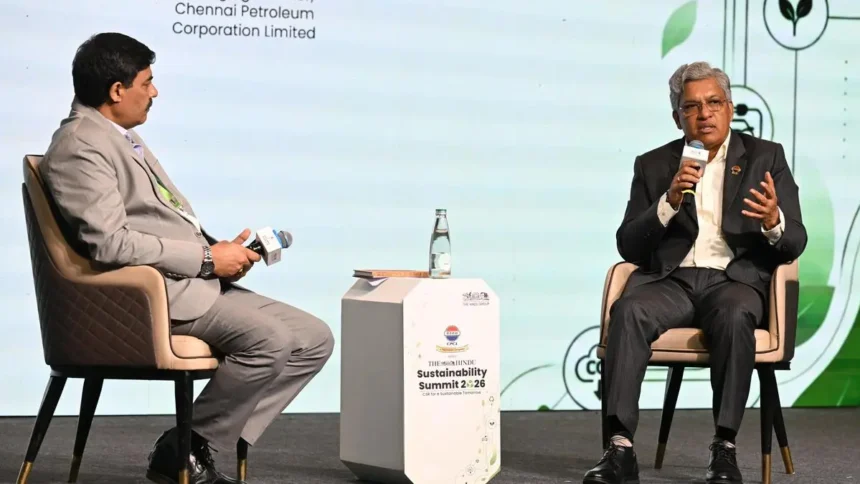
The Chennai Petroleum Corporation Ltd (CPCL) has been able to navigate the West Asia crisis by leveraging its ability to process a wide range of crude grades and maintaining high refinery utilisation, its Managing Director H Shankar. said at The Hindu Sustainability Summit 2026, held at ITC Grand Chola in Chennai on Wednesday.
“We process more than 160 types of crudes in our refinery. This gave CPCL the flexibility to source crude based on availability and adjust its processing to meet product requirements,” he said during the fireside chat with N Ravikumar, Senior Deputy Editor, The Hindu, on Refinery to Energy Hub: A Vision for the Future, at the Summit presented by CPCL.
Speaking at a discussion on the company’s future, Shankar said the West Asia crisis was the latest in a series of disruptions that CPCL had faced since the Covid-19 pandemic, including the Russia-Ukraine war. Operational excellence, higher reliability and crude flexibility had helped the refinery respond to these disruptions.
The company has maintained capacity utilisation of 100 per cent and above over the past five years, while improving reliability and energy efficiency, he said.
Shankar said that the experience of the past five years had also reinforced the need for refiners to prepare for changes in the energy mix. While hydrocarbons would remain important, CPCL expects transportation to gradually move towards electric vehicles, hybrids and CNG, requiring refiners to alter their product mix.
“Refinery as such will be very much in existence,” he said. However, the product mix would have to increasingly shift from fuels towards petrochemicals.
CPCL and its parent Indian Oil Corporation are reviewing a proposed project at Nagapattinam. Originally planned as a 9-million-tonne refinery with a small polypropylene component, the project is now being evaluated as a petrochemical-focused complex.
“We are looking at the opportunity to move into the petrochemical sector directly,” Shankar said. The land acquired at Nagapattinam could be used for higher-value petrochemical streams instead of developing a fuel-focused refinery first and adding petrochemicals later.
At its existing Manali refinery, CPCL is expanding its lube oil base stock production from Group I to Group II and Group III, with import substitution among the objectives.
The company is also evaluating compressed biogas, sustainable aviation fuel and green hydrogen as part of its transition strategy. CPCL has aligned its net-zero target with IndianOil’s 2046 goal.
Shankar said energy-efficiency initiatives had helped CPCL move into the top quartile in Solomon Associates’ refinery energy-efficiency benchmarking.
The company is also diversifying into retail, with three ‘Super’ branded outlets operational around Chennai and plans to expand across Tamil Nadu. AI and digital technologies are being deployed for equipment-health monitoring, predictive maintenance and safety during refinery turnarounds.
Published on September 23, 2026