



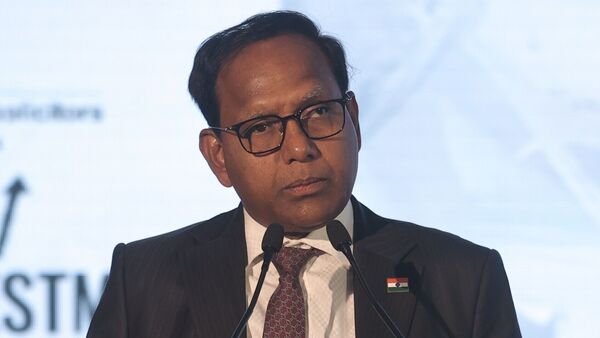
Banks were incurring costs on merchant verification, QR deployment and support without receiving any return from larger merchants under the zero-merchant discount rate (MDR) regime, M. Nagaraju, former secretary at the department of financial services (DFS), said in an exclusive email interview with Mint.
The former DFS secretary said the government’s reassessment of the zero-MDR model was driven by the rapid increase in Unified Payments Interface (UPI) transaction volumes and the widening gap between the cost of running the ecosystem and the government’s support.
UPI is set to move to a new pricing framework from 15 October, under which a 0.4% MDR will apply to specified person-to-merchant transactions above ₹2,000, subject to a ₹300 cap. Person-to-person transactions and eligible small merchants remain outside the charge framework.
He said the issue was not an immediate crisis but a growing sustainability concern that had been formally brought to the government’s attention. “I would not describe as a crisis, but the risks were real, and they were formally placed before the government.” Edited excerpt:
In 2025, the government had not taken any decision to introduce MDR on UPI. The statement issued at that time responded to media reports claiming that such a decision had been made. Industry bodies, including the Payments Council of India, had raised concerns about the sustainability of the zero-MDR model, and those concerns were examined along with the growth and operating cost of the system.
Two developments shaped the decision. The first was scale. In August 2026, UPI processed 24.51 billion transactions worth ₹29.82 trillion, a 22% increase in volume over August 2025. The second was the gap between the cost of running the system and the support available.
The Parliamentary Standing Committee on Finance, in its 44th report submitted in August 2026, cited an industry estimate of around ₹207 billion as the annual operating cost of the UPI ecosystem. The government’s 2026-27 allocation for RuPay and low-value UPI incentives is ₹2,000 crore, which covers about 11% of that cost. The committee recommended a sustainable revenue model that protects small merchants and person-to-person transactions while drawing revenue from higher-value merchant payments.
Government incentives were designed as bridge funding to support early adoption, not as a permanent source of funding. Relying on annual budget allocations also makes long-term investment in capacity, cybersecurity and fraud prevention difficult for banks and payment companies to plan.
The legal framework was put in place through the Taxation and Other Laws (Amendment) Act, 2026, which amended Section 10A of the Payment and Settlement Systems Act, 2007. This is an enabling provision that allows the government to notify which payment modes remain protected from charges. The UPI and Services Steering Committee, headed by the National Payments Corporation of India (NPCI), then decided the scope and structure of the MDR. Consumers, person-to-person transfers and small merchants continue to use UPI free of charge.
I would not describe it as a crisis, but the risks were real, and they were formally placed before the government. The NPCI and industry bodies were seeking reconsideration of the zero-MDR policy for UPI and RuPay debit cards for the last five to six years. As I said, the Parliamentary Standing Committee on Finance, in its 44th report, warned that inadequate funding could affect investment in cybersecurity, fraud prevention and payment network infrastructure.
The main concern was the direction of costs, not an immediate breakdown. The ecosystem supporting UPI needs continuous investment in capacity and security. Merchant onboarding in smaller towns also carries costs for banks, since each merchant requires verification, QR deployment and support, and zero MDR provided no return on that effort for larger merchants.
The framework addresses these concerns directly. The MDR on higher-value merchant payments provides a predictable source of funding for infrastructure and security.
The ₹2,000 threshold follows the line already used in the government’s incentive scheme for low-value UPI transactions, which supported small-merchant payments up to ₹2,000. Transactions up to this amount account for more than 95% of person-to-merchant volume, so everyday purchases such as groceries, local transport and small payments remain free. Transactions above ₹2,000 are about 4% of person-to-merchant volume but around two-thirds of its value. A charge on this small share of transactions can support the system without affecting routine use.
The rate and other parameters were finalized through the UPI and Services Steering Committee, headed by the NPCI, which includes banks, payment companies and industry bodies such as the Payments Council of India and the Indian Banks’ Association. The rate is well below the cost of card acceptance, where credit card MDR typically ranges from 1.5% to 2.5%. The charge is capped at ₹300, which applies from ₹75,000, the point at which 0.4% reaches ₹300.
Essential and low-margin sectors, including railways, telecom, insurance, fuel and utilities, pay a flat ₹5 per transaction above ₹2,000. These sectors account for about 17% of person-to-merchant volume but about 46% of its value, so a percentage charge would fall heavily on essential services.
The operational parameters were decided by the UPI and Services Steering Committee, following consultation with the government and RBI. Different stakeholders examined the rate, threshold and exemptions from their own perspectives, and that process shaped the final design. RBI has publicly supported the framework as a step towards the long-term sustainability of digital payments. Coordination is continuing: the framework for the small merchant fund will be finalized in consultation with RBI within the next three months.
The zero-MDR policy introduced in January 2020 was meant to accelerate the adoption of digital payments, and it has achieved that objective. Government incentives during this period were designed as short-term bridge funding. Most payment systems globally, including digital public infrastructure, have economic models that support ongoing investment. UPI has now reached a stage where its funding model should reflect its scale, while protecting accessibility for citizens and small businesses.
I do not believe the decision was delayed. Introducing charges earlier, while small merchants and first-time users were still adopting UPI, could have slowed that growth. During this period, costs were shared by banks, payment service providers and government incentive schemes. The decision was taken once UPI had reached a scale where a limited merchant-side charge would not affect its use for everyday payments.
This is a calibrated framework with defined protections. P2P transfers remain free for any amount. Merchant payments up to ₹2,000 remain free. Small merchants (largely from unorganized sector) under the P2PM category. Payment apps cannot charge consumers a platform fee, and there are no monthly limits on free usage. The MDR is distributed within the UPI ecosystem for infrastructure, cybersecurity, innovation and customer service. It is not a revenue measure for the government. The framework will be reviewed on the basis of data, but there is no proposal to introduce charges on consumers.
Merchants onboarded for UPI cannot pass the MDR on to customers, and payment apps cannot levy platform fees or any other charge on UPI payments. Customers should pay only the listed price. For large merchants and e-commerce platforms, a charge of 0.4%, capped at ₹300, is lower than the cost of accepting credit cards. Payment acceptance is a normal business cost, offset by higher footfall and lower cash-handling costs.
Consumers do not incur any charges for UPI payments, so there is no reason for them to change payment methods because of this framework. For merchants, UPI remains among the lowest-cost ways to accept digital payments. The digital rupee is being developed by RBI, according to its own roadmap and objectives. UPI and CBDC serve different purposes and can grow alongside each other.
We will monitor merchant acceptance and transaction patterns closely. It should be noted that moving customers from UPI to credit cards would raise a merchant’s costs, since card MDR is several times higher. We therefore do not expect merchants to have a commercial reason to discourage UPI. The UPI and Services Steering Committee can review the parameters if sustained data shows unintended effects. Any review will be based on evidence rather than early reports.