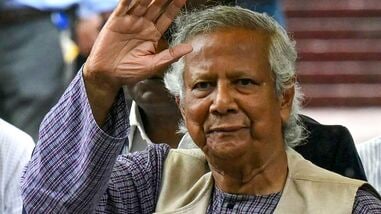
Muhammad Yunus, who headed Bangladesh’s interim government after Sheikh Hasina’s ouster, faced an angry confrontation with Bangladeshi expatriates at New York’s John F. Kennedy (JFK) International Airport on Monday.
Yunus was called a “terrorist” and accused of being responsible for killings and undermining democracy in Bangladesh. Several protesters shouted allegations at the Nobel laureate as security personnel escorted him out of the airport in a wheelchair.
“You terrorist. You have killed people in . Why have you come here? Tell us, why have you come?” a man was heard shouting at Yunus in a video circulating on social media.
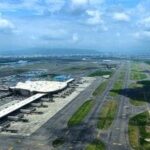
The confrontation took place after arrived at Terminal 8 on a Qatar Airways flight from Doha.
He and his aide, Lamia Morshed, subsequently returned inside the airport, where security personnel intervened and escorted him away.
The protesters also accused Yunus’s administration of being responsible for the deaths of thousands of police personnel and alleged that around two lakh people had been arrested in .
The confrontation reflects anger among some Bangladeshi expatriates over political violence, arrests and allegations of abuses during Yunus’s tenure as head of the interim administration.
Critics have accused the interim government of failing to respond adequately to violence and of not ensuring accountability for alleged abuses.
Calls for investigations into Yunus and allegations concerning his broader business interests have also emerged, according to reports.
Yunus’s interim administration faced criticism over reports of attacks on Hindu communities and places of worship, allegations of arbitrary arrests and custodial deaths, and concerns about the treatment of political supporters.
Rights groups also raised questions about accountability for abuses linked to the July-August 2024 uprising that led to Hasina’s removal.
In January 2026, an ordinance introduced by Yunus’s administration concerning alleged offences committed during the uprising drew scrutiny over its implications for criminal investigations.
According to reports, the measure restricted routine criminal investigations by police and other law enforcement agencies into certain actions by uprising participants, referring allegations to the National Human Rights Commission () for assessment.
The ordinance raised questions about how allegations involving killings and other serious offences would be investigated and whether the mechanism would ensure accountability. The precise scope and legal effect of the measure should be established from the ordinance itself.
Relations between New Delhi and Dhaka came under strain during Yunus’s tenure, with disagreements over regional security, minority rights and political rhetoric adding to existing tensions.
Yunus drew criticism in India after remarks he made during a visit to China in March 2025 concerning strategic position and India’s northeastern states. His comments prompted concerns in India about their implications for regional connectivity and security.
The safety of Hindu minorities in also became a recurring point of contention. New Delhi called for the protection of minorities, while the two sides exchanged concerns over developments in their respective countries.
These disagreements unfolded against the backdrop of presence in India after her removal from office.
Yunus stepped down as head of Bangladesh’s interim administration on February 16, ahead of the transfer of power to an elected government.
The identities of the people involved in the confrontation at JFK airport have not been independently confirmed.
However, Bangladesh Prime Minister’s Information and Communications Adviser Zahed Ur Rahman said on Tuesday that Dhaka would take legal action against them.