



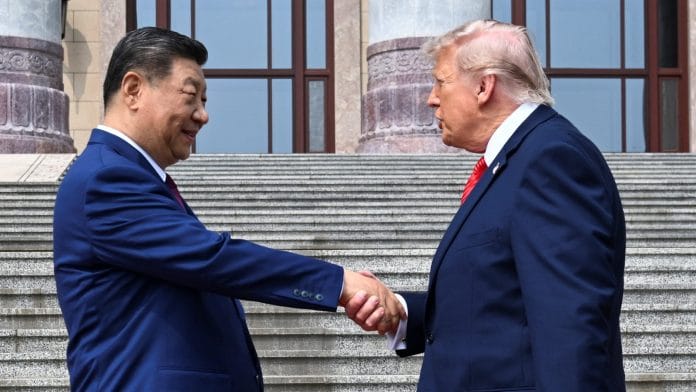
Nor is an actual war between two powers – one established and the other rising – the only demonstration of the Thucydides Trap. It can include economic warfare too. When Trump imposed tariffs, China responded by restricting the export of rare earth magnets, threatening entire industries dependent on this vital source of supplies. And this applied even to countries that were not threatening China with tariffs. Management and strategy guru Ram Charan, in a new book China’s 90% Model, suggests that the Chinese method of warfare is economic, which includes building massive production monopolies that rise up to 90 percent in several critical industries – which gives it the potential to threaten anyone who does not toe its line or accepts its demands.
This does not look like China has understood the wider implication of the Thucydides Trap that may go beyond actual war. Economic and information warfare is still warfare.
The Thucydides Trap is not just about one country feeling worried about the rise of another; it could equally work if two powers work in unison or separately to keep a third rising power down. In this case, the trap is not just about the US trying to keep China down, but both together trying to keep India, and future rising powers, down by instigating internal strife, economic and political sanctions, and even war.
The idea can be applied across-the-board to almost any power relationship in the world, whether it is corporate power, gender power, demographic power, or academic and intellectual power.
When women start rising in the power hierarchy, men feel threatened. When innovators threaten existing monopolies, again the latter seek to contain the threat by undercutting and other actions. The entire intellectual property rights (IPR) protection regime, which is justified to ensure that true innovators benefit from their efforts, is also an indirect effort to stifle competition in the name of protecting IPR.
The trap applies in all power relationships. When political leaders or corporate chiefs or even spiritual gurus fail to indicate a succession line, they too are fearful about the loss of power once they are no longer at the centre of power.
The issue emanates from a basic human fear: we all fear the loss of power, and the only solution to it is to make the mental adjustment that focuses you on things beyond temporal or material power.
This is what the four purusharthas (lifecycle goals) – brahmacharya, grihastha, vanaprastha, and sanyasa – imply. At some point, you must cede power and move on to other things. Once you are nearing the end of the grihastha stage of being a householder and acquirer of wealth and power, you need to transition to vanaprastha, where you start moving away from day-to-day responsibilities and hand over power to others who are now entering the stage of wealth and power. This does not imply that you totally withdraw, but that your focus needs to shift elsewhere to inner growth.
When countries are threatened by new rivals, they should create space for the new entrants to improve their lot and seek higher goals for themselves. Companies regularly do that when they see new competitive players by shedding labour-intensive products and moving on to higher-value businesses.
The laws of nature follow a predictable pattern of creation, stabilisation, creative destruction and renewal or rebirth – the Brahma-Vishnu-Mahesh roles of gods.
The Thucydides Trap, which is one version of this basic natural reality, means the powerful must make way for those rising in the world and pursue other goals more worthy of their power. Trying to destroy others in order to maintain your own supremacy is ultimately doomed to fail. The US, and China, and India, when its time comes, must be willing to make this mental adjustment to the reality of power shifts without giving in to win-lose thinking.

