



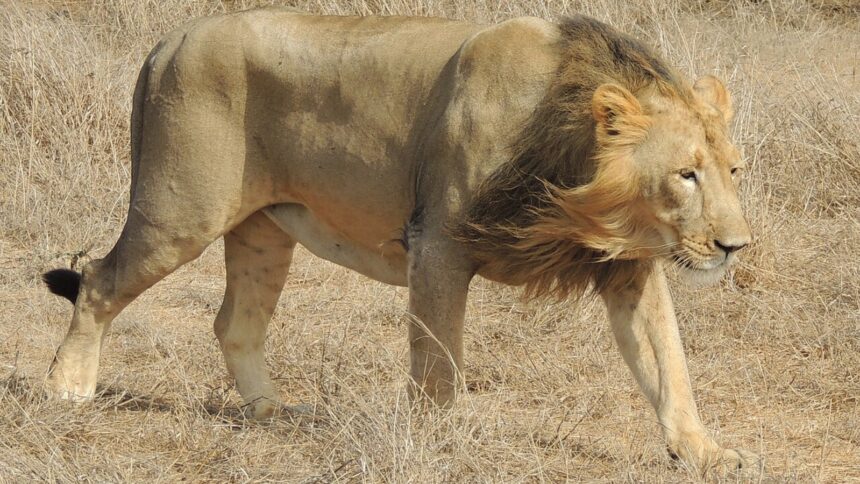
In Gujarat’s Gir region, eight lions, including cubs, recently died due to a suspected Babesiosis infection caused by the Babesia parasite. The state Forest Department has responded by isolating lions residing within a 10-km radius of affected areas in Gir Somnath and Amreli districts and initiating treatment for animals suspected to be infected.
While authorities have described the measures as precautionary, the incident has renewed concerns about the vulnerability of the world’s only wild population of Asiatic lions to disease outbreaks. According to wildlife biologist and conservation scientist Ravi Chellam, the current situation highlights a much deeper conservation challenge.
A disease outbreak in a wild and free-ranging population of an endangered species is always worrisome,” says Chellam. He points out that Asiatic lions have historically passed through severe population bottlenecks, resulting in reduced genetic diversity.
“As the Asiatic lions are inbred, it is likely that their immunity levels are reduced. Additionally, since all the wild Asiatic lions exist as a single population,
The challenge extends beyond the protected forest itself. According to Chellam, nearly half of the lion population now lives outside protected areas. “About 50% of the lions live outside the protected area in human-dominated habitats and are exposed to many domestic animals, carcasses and the pathogens they carry,” he says.
Reiterating the same, conservationist Indrajit Ghorpade further explained that modern human chemicals, pesticides, and infections of domestic animals transmit diseases.
Tick-borne diseases such as Babesiosis can be particularly concerning because vectors and hosts may be widespread across the landscape, making management difficult. “Since all the lions exist as a single wild population, it places them at great risk, especially from disease outbreaks,” Chellam adds.
One of the key measures announced by the Forest Department involves isolating lions within a 10-km radius of affected areas. But Chellam questions how practical such an approach is in an open landscape. “The question to ask is how one isolates lions from such a large area without using barriers?” he says.
Reports indicate that several lions have been captured and moved to facilities for treatment and monitoring. However, Chellam notes that lion behaviour itself may complicate such interventions.
“Lions are territorial animals. Gir and the surrounding areas have a high-density population of lions. Once free-ranging lions are captured and moved from their established territories, other lions will quickly occupy the vacated territories,” he explains.
This creates a challenge when authorities attempt to release treated animals back into the wild. “The release of the captured lions even after a few days is not guaranteed to succeed, as these lions would have lost their territories,” says Chellam. He further points out that lions taken into captivity are often not released immediately. “In reality, when lions are captured in Gir, they are held captive for weeks if not months.”
The central issue, according to Chellam, is that the entire wild Asiatic lion population remains concentrated in a single landscape. He points to a landmark decision by the Supreme Court of India. “The Asiatic lions in Gir face numerous conservation threats, including diseases. This is why the Supreme Court of India on April 15, 2013, ordered the translocation of lions from Gir to Kuno However, the plan has yet to be fully implemented.

