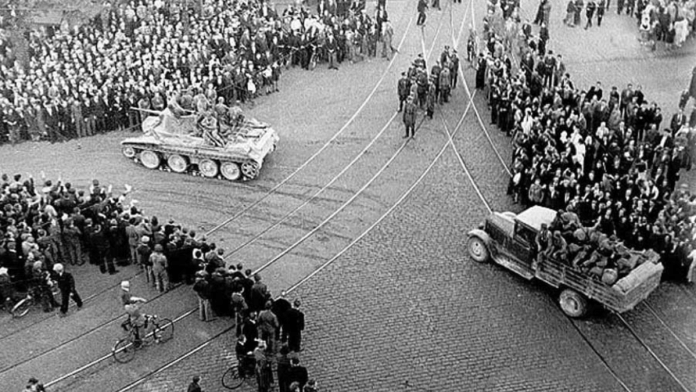
For us, the end of the Second World War did not bring freedom. Instead, it marked the beginning of nearly five decades of Soviet occupation. As a result, we were not able to stand among the nations signing principles that are so fundamental to us, and remain so for the world today.
The Second World War in Europe began not only with the Nazi aggression, but with the calculated cooperation of two totalitarian regimes. In 1939, Nazi Germany and the Soviet Union signed the Molotov-Ribbentrop Pact and its secret protocols, which divided Eastern Europe into spheres of influence.
Within weeks, the Soviets and the Nazis invaded Poland, coordinating their actions to dismantle a sovereign state. The Baltic region was effectively assigned to Soviet control, and soon the Red Army moved into the Baltic region as well.
Despite having declared neutrality, in 1940, the independent nations of Estonia, Latvia, and Lithuania were occupied and illegally annexed by the Soviet Union through Red Army takeover first, and later by staging the popular referenda to fabricate the legitimacy for the takeovers.
When Nazi Germany invaded the Soviet Union in 1941, the Baltic states fell under yet another brutal occupation. And in 1945, as the Red Army drove the Nazi menace out of the Baltics, Soviet rule was reimposed. The Baltic states were repeatedly caught between occupying powers.
From the outset, the Soviet rule in the Baltic states was enforced through repression and massive displacements of populations. The Soviet occupation uprooted entire communities, forcing them to become refugees abroad. Tens of thousands of Estonians, Latvians and Lithuanians were deported to Siberia and other remote regions within the Soviet Union under brutal conditions. While many never returned, the remaining survivors came back traumatised and ostracised.
These repressions were designed to dismantle independent statehood in Estonia, Latvia and Lithuania and reshape our societies to fit the needs of imperial Soviet power. National institutions were eliminated, our economies were forcibly reorganised, cultural life was tightly controlled, contacts with the outside world were limited to a bare minimum, under strict KGB supervision, and religious life was suppressed.
The Soviet system in the Baltic states was not a partnership of peoples as often presented to the world—it was a prison of nations maintained by brute force.
The portrayal of the Soviet Union as a liberating force continues to be promoted. While the Soviets contributed to the Allied victory over Nazism, it is generally overlooked that they became occupiers, perpetuating the legacy of the Soviet-Nazi deal of 1939.
Such narratives are not neutral in today’s Russia, which is invoking twisted interpretations of history to justify its illegal, unprovoked and unjustified war of aggression against Ukraine. False claims about the historical unity between Russia and Ukraine, security imperatives or moral mission “to liberate” are used to rationalise what is, in essence, a continuation of imperial ambition directed against Ukraine.
For the Baltic states, which have lived the consequences of such narratives, the pattern of imperial rhetoric emanating from Moscow is unmistakable.
More than eight decades after the outbreak of the Second World War, the responsibility to confront historical truth remains. The defeat of fascism was a turning point for humanity. Yet for many nations, this victory did not result in freedom.
For Estonia, Latvia, and Lithuania, the Soviet period represents an occupation in an era otherwise defined by the rejection of imperial rule. Instead of regaining independence after 1945, we were absorbed into the Soviet system that reproduced many of the core features of imperial rule. The Soviet Union, despite its anti-imperialist rhetoric, acted as a successor of the Russian Empire—expanding, consolidating, and governing through terror.
Remembering this is essential—not only for our nations, but for a better global understanding of how an imperial power can mask its true face under the guise of anti-imperial rhetoric.
In countries like India, with its own history of colonialism and struggle for independence, the principles of sovereignty and territorial integrity are deeply understood. We believe that sharing our experience contributes to a broader understanding of why these principles must be defended today.
H.E. Ms. Diana Mickevičienė is the Ambassador of Lithuania in India. Ms. Inga Skrūzmane is the Chargée d’affaires of Latvia in India. H.E. Ms. Marje Luup is the Ambassador of Estonia in India.