



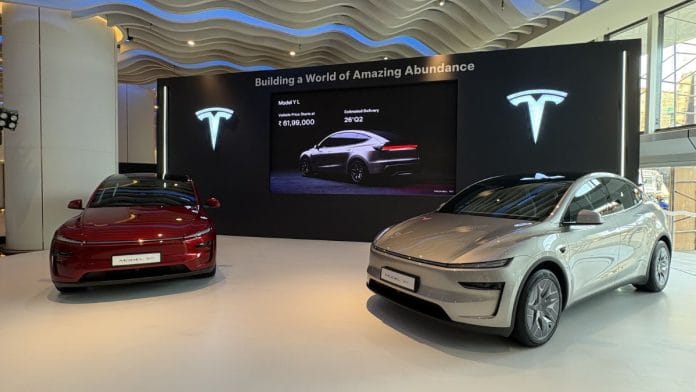
Available in one specification, the Model Y, priced at Rs 61.99 lakh (ex-showroom), is the most affordable luxury three-row vehicle in the market. Tesla officials were really optimistic about how this vehicle would do, especially as the American carmaker has barely made a dent on the sales charts in the six months since entering the Indian market.
Beyond sales, this launch highlighted something else in India: the rise of the Chinese aesthetic in cars and SUVs. While the Tesla launch was going on, the Beijing Auto Show had begun across our Eastern border. According to a Reuters report, 181 cars are to be unveiled there.
For context, even at the Delhi Auto Expo—now rebranded as the Bharat Mobility Global Expo—it’s rare to see more than 15 or so major unveilings. What stood out in Beijing, however, wasn’t just the scale but the direction: many of the launches, particularly from German manufacturers, reflected how China—not Europe or the United States—is increasingly shaping the global automotive narrative.
You could have guessed that from the sheer volume of cars on display, including next-generation versions of globally iconic models like the Mercedes-Benz C-Class.
Let me explain. Tesla was almost forced to develop this three-row Model Y L to cater to the Chinese market, where such three-row SUVs have become extremely popular. I call such vehicles MPSUVs, and they’ve become very popular in India, as well as the runaway success of the Mahindra 700/7XO has proven.
Right now, I’m driving a Mahindra XEV 9S, India’s best-selling electric vehicle, with over 7,500 units moved over the last couple of months. And it isn’t just these hybrid MPSUVs, but large vans in general are in demand. In India, we have the MG M9, coincidentally from the Chinese market.
But there is another aspect of the Chinese design aesthetic, which is especially visible in car interiors: large screens. You’ve seen it on the latest Mahindra and Tata vehicles, which are clearly inspired by developments in China.
Even in the new C-Class and the facelift of the BMW 7 Series, screens and technology are everywhere. The C-Class has one continuous screen running the entire length of the dashboard. It’s very different from the old European luxury vibes. Even Toyota bZ, unveiled at the show, sacrifices Japanese minimalism for Chinese bling. And then there is the long-wheelbase phenomenon, German carmakers used to making taut performance sedans started to lengthen their cars for Chinese consumers who cared more about comfort than performance. It is telling that when those same long-wheelbase vehicles were introduced in India, sales for BMW and Mercedes rose dramatically.
Mahindra and Tata have drawn lessons from Chinese carmakers. Because they have realised that while India and China aren’t diplomatically aligned, our consumers like the same things. We like three-row SUVs because family is important, and we like going on outings together. Both countries have an emerging (well, more emerged in China) consumer class that wants everything in their cars—the latest technologies, screens, sunroofs, and incredible performance.
The experiences of Tesla and global carmakers reflect this shift. They will kowtow quite literally to the Chinese consumer and market. The new Hyundai IONIQ V launched at the same show is a remarkable vehicle with a unique sportback design and is loaded with Chinese technology from companies like Huawei; incidentally, so is the Toyota mentioned above.
It is a pity I couldn’t travel to the Beijing Auto Show, because the event felt like a case of the dragon flexing its muscles. While US President Donald Trump may have delayed the inevitable in the US, events and launches of the past week have demonstrated that the global auto industry is increasingly operating in a Chinese world.
(Edited by Ratan Priya)

