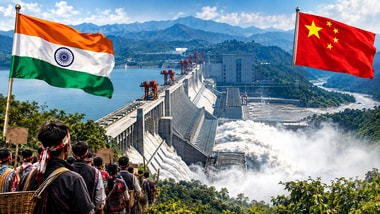
India’s proposed 11,200-megawatt Siang Upper Multipurpose Project (SUMP) in Arunachal Pradesh is about more than generating electricity.
For New Delhi, the project is likely a strategic safeguard against China’s massive hydropower development upstream on the Yarlung Tsangpo river in Tibet.
But the proposal has triggered strong local opposition, with protests escalating into violence in October over fears of displacement, loss of ancestral land and environmental damage.
Fresh research by Chinese scientists has added another dimension to the debate. Researchers from the Chinese Academy of Sciences and Yunnan University have warned that runoff in the Yarlung Tsangpo could increase over the course of this century, potentially raising the frequency of high-flow events, including floods.
According to the South China Morning Post, the researchers reconstructed the river’s runoff history from 1325 to 2020 using tree-ring data from the southeastern Tibetan Plateau.
The river flows east across Tibet before turning south through the Himalayas into Arunachal Pradesh, where it is known as the Siang. It then flows into Assam, forming the main channel of the Brahmaputra, before continuing into Bangladesh.
China is developing a reported 60,000-MW hydropower project at Medog on the Yarlung Tsangpo. Its location upstream of India has raised concerns about how dam operations could affect water flows downstream, including the possibility of sudden releases or reduced flows during dry periods.
The proposed SUMP is intended to generate electricity while storing and regulating water. Arunachal Pradesh Deputy Chief Minister Chowna Mein said in October that the project should not be compared with China’s Medog project on power-generation capacity alone.
According to figures cited by Mein, SUMP could provide around 9.2 billion cubic metres of live storage, compared with an estimated 5.5 billion cubic metres for the Chinese project. Live refers to the portion of a reservoir available for managing water releases.
The state government argues that the reservoir could help regulate water flows and reduce flood risks in the Siang basin and downstream areas of Arunachal Pradesh and .
By holding back some incoming water and releasing it in a controlled manner, a reservoir can help moderate peak flows under suitable conditions.
The project could also add significant capacity to India’s electricity supply, support the Northeast’s energy needs and create employment and infrastructure opportunities.
In June 2025, Union minister described the project as a strategic necessity for India’s national security, linking it to China’s upstream hydropower plans, as per a News18 report.
For residents of the Siang Valley, the project raises immediate concerns about their homes, land and way of life.
Members of the indigenous Adi community and other local groups fear that the proposed dam could submerge ancestral land, displace villages, damage the local environment and threaten traditional livelihoods and cultural heritage.
Opposition has also centred on preliminary survey work for the project’s pre-feasibility report. Protesters have demanded that the survey process be halted and that affected communities be consulted before the project moves forward.
In October 2026, demonstrations escalated into clashes in parts of Arunachal Pradesh.
According to reports, the in Pasighat turned violent on 23 October, with police reporting stone-pelting, injuries to personnel and damage to public and private property.
The Siang Upper Multipurpose Project has become a test of how India balances strategic interests with local concerns.
China’s upstream dam plans have sharpened India’s focus on water storage and river management.