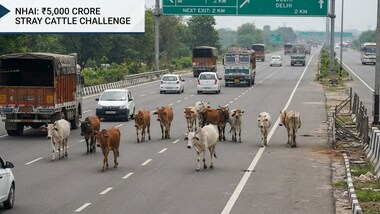
Removing stray cattle and other animals from India’s highways could leave the National Highways Authority of India (NHAI) facing a bill of more than ₹5,000 crore. The authority has told the Supreme Court that it does not have the legal powers or financial resources to carry out the exercise, arguing that State governments and local bodies should take responsibility instead.
The submission puts the spotlight on who should bear the cost of keeping highways free of stray animals, a problem that has long posed a safety risk to motorists.
During a hearing on November 17, Solicitor-General Tushar Mehta, representing NHAI, asked the Supreme Court to reconsider its November 2025 directions. He argued that the authority’s existing legal framework does not permit it to take on the responsibility of capturing , shifting them to shelters and arranging their rehabilitation.
According to Mehta, State governments are better placed to handle the task because they have access to contingency funds.
The court was not entirely convinced by the argument that NHAI could not contribute towards the exercise.
The Bench of Justices questioned how the authority used the toll revenue collected from highway users. It also stressed that preventing accidents caused by stray animals was a matter of public safety.
The judges suggested that NHAI could explore a limited role rather than assume responsibility across the country. One possibility discussed was setting up animal shelters near toll plazas or in individual districts.
Mehta, however, maintained that the authority had already assessed the financial implications and could not afford the additional expenditure.
The Bench reserved its order on NHAI’s request but indicated that it was not inclined to change its earlier directions.
The dispute stems from a set of directions issued in November 2025, requiring NHAI, State governments and Union Territories to remove stray cattle and other animals from highways.
The animals must be moved to suitable shelters, gaushalas or cattle pounds, where they should receive food, water and veterinary attention.
The court also called for dedicated highway patrol teams to monitor roads around the clock. Helpline numbers must be displayed prominently so commuters can report stray animals and related accidents.
Its directions extended beyond highways. Authorities were also asked to remove stray dogs from schools, hospitals, sports complexes, bus stands, railway stations and other to designated shelters after sterilisation and vaccination under the Animal Birth Control Rules, 2023.
The hearing also brought attention to gaps in the implementation of the court’s directions by State governments.
Senior advocate Gaurav Agrawal, assisting the Bench as amicus curiae, said some States had designated existing veterinary institutions as animal birth control shelters without establishing separate facilities or providing additional staff.
The court questioned whether such arrangements would be sufficient, stressing that simply naming an institution as a shelter would not solve the problem without adequate manpower.
States and Union Territories had also been directed to secure schools, colleges, hospitals and public transport facilities with boundary walls, appoint nodal officers and arrange regular inspections.
The Supreme Court is expected to pass orders on NHAI’s application after considering its request and the compliance reports submitted by the States.