


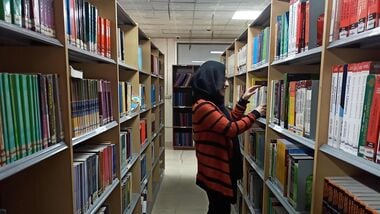
government has withdrawn over 4,700 books, including banned ones, containing objectionable content from colleges and libraries across the Union territory after scanning nearly 2.2 million publications, news agency PTI said. Nearly 94 per cent of the withdrawn books, were from the Kashmir division while 253 withdrawn from Jammu .
The information was revealed by the UT government in a a written reply to a question in the assembly by Awami Ittehad Party (AIP) MLA from Langate, . The government said it has examined 21,81,582 books/publications till date, in the reply during the assembly session.
Out of these, 9,32,941 were examined in Jammu division, while 12,48,641 in Kashmir division, the Higher Education Department said in its reply. The government said it has withdrawn from circulation 4,767 books including 518 banned publications.
While 293 books have been withdrawn in Jammu region, 4,474 have been withdrawn from the Kashmir valley.
The government has also referred 1,752 books – 538 in Jammu and 1,214 in Kashmir – for expert examination to director of colleges. It said a clear and objective criteria has been adopted for identifying objectionable material for scrutiny of books available in colleges.
However, it added, that the process of scrutiny of objectionable books/material to be withdrawn is under process in the department.
The government said the ‘withdrawal’ of books is part of wider scrutiny exercise covering books and other publications available in educational institutions and libraries.
The government asserted that the reason for such action is that the higher education institutions constitute centres of higher learning, research, academic excellence and are expected to foster an environment that upholds constitutional values, academic freedom, critical thinking, scientific temper, responsible citizenship and respect for the sovereignty, unity and integrity of India.
The scrutiny follows orders issued in July by the education department and universities to screen all books following a controversy over procurement of two books which had objectionable content.
The figures released by the do not include books that had already been formally banned. Separately, the government informed the assembly that 518 copies of 19 titles banned under S.O. 203, dated August 5, 2025, had been removed from circulation.
In August 2025, the J&K Home Department banned 25 books by academics, journalists, writers and historians, citing concerns that they promoted what the government terms “false narratives, radicalisation and secessionism.” The list included works by Arundhati Roy, AG Noorani, Sumantra Bose, Sugata Bose, Christopher Snedden and Victoria Schofield.
The crackdown on books gathered momentum this year after a controversy over two books supplied to school libraries under the Samagra Shiksha programme. The allegations were that the books contained favourable references to separatist leaders and used terminology associated with secessionist politics.
The wider scrutiny centred on Personalities and Legends of J&K, written by Hilal Ahmad and Santosh Meena, and Great Personalities of Jammu and Kashmir, written by Sushant Giri.
The education department is using a three-tier “academic and content scrutiny mechanism” to review the material. The mechanism includes committees at the college level, directorate level and administrative department level.
The department has also adopted what it described as “clear and objective criteria” for identifying material considered objectionable.
A circular issued in July called for a transparent and accountable system for the evaluation, procurement, recommendation, retention, circulation and periodic review of academic material.
The guidelines require publications to be reviewed for their academic relevance, factual accuracy and pedagogical suitability. They must also conform to the Constitution of India, applicable laws, University Grants Commission regulations, government policy and the educational objectives of the Higher Education Department.
(With agency inputs)