



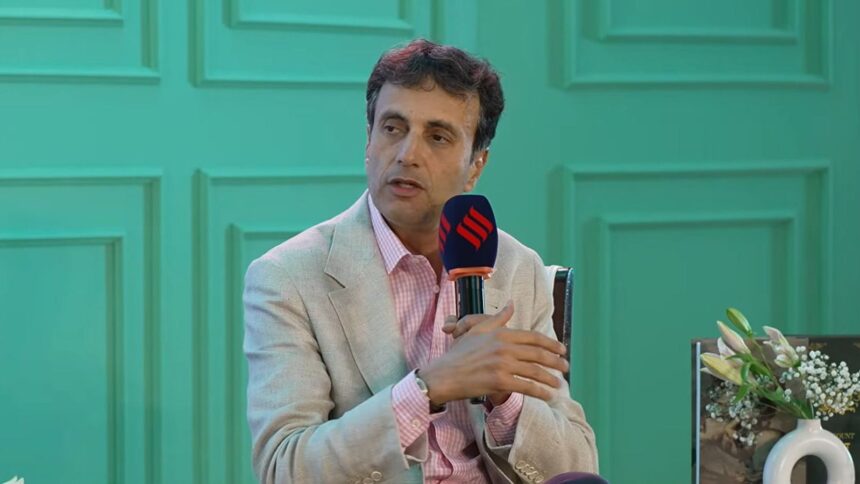
India is struggling to attract foreign investment partly because global capital is increasingly concentrated around artificial intelligence (AI), with foreign investors currently viewing the country as an anti-AI play, according to Ruchir Sharma, the chairman of Rockefeller International, founder & CIO of Breakout Capital and an acclaimed author.
In conversation with Anant Goenka, Executive Director, The Indian Express Group, at Express Adda held on Tuesday, April 28, Sharma pointed to the lack of AI infrastructure as one of the biggest reasons why foreign investors are indifferent towards India at the moment.
“The picks and shovels, semiconductors, memory, and the compute. That’s the phase. It is a mad dash going on for that. India, unfortunately, just does not have that, as per the sentiment among foreign investors,” he said. “You see a desperate run to win the AI arms race. The biggest beneficiaries are countries which have the infrastructure,” Sharma further said.
Foreign fund outflows have emerged as a key concern for Indian markets, with overseas investors selling roughly $50 billion worth of equities over the past few years. Alongside flat net foreign direct investment (FDI), it has raised broader questions about India’s ability to attract global capital. Pointing to the data, Sharma said that it is vital to understand why foreign investors are reducing their exposure to India in the first place.
“The entire world today has a mono-maniacal focus, which is AI. The focus is on the winners of AI and the losers of AI. Unfortunately for India, in contrast to what happened during the tech boom (1999-2000), most foreigners have taken the view that India is a loser in the AI context,” he said.
While stating that India is not seen by foreign investors to have any , Sharma said, “This can change. We can get to a different phase of adoption, where India can end up becoming a beneficiary of AI. But the current reality is this.”
In terms of AI adoption, Sharma said India is still at a relatively early stage mainly because of the lack of adequate spending for research and development.
“I have never seen such indifference towards India. This is because they are focused on one thing for now, which is AI. Whether you have it or not. Here, the structural weakness for India shows itself up. The amount of money spent on India for R&D as a share of GDP is 0.6 per cent. Korea and Taiwan, which are among the biggest beneficiaries of the AI boom, spend about 4-5 per cent of their GDP on R&D,” he said.
When asked about the fears of AI-led disruption of software, which has led to a significant correction in Indian IT stocks in 2026 so far, Sharma said, “They will be there. The big ones have an opportunity to reinvest themselves. But currently I have no money invested (in that space).”
The onground difficulties of doing business in India was highlighted by Sharma as another factor in why private capital investment is not picking up here. India is “still a very difficult place to do business on the ground. Whether it is the regulatory framework, investigative agencies, it is a difficult place. India consistently disappoints the optimist and the pessimist. In terms of valuation, India is still the third highest. China is still among the cheapest,” he said.
Although India is currently viewed as an anti-AI play, Sharma said he expects this dynamic to eventually shift as the global economy cannot remain driven by a single theme or factor indefinitely. “If you are a true contrarian, this could be the time to play India. But that’s a view. The reality is what I am talking about now,” he said.

