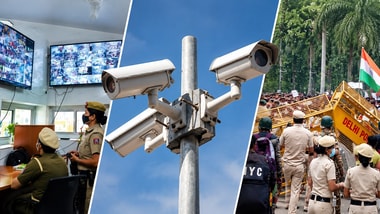
A ₹15.7-crore Delhi Police tender to install 338 surveillance cameras with facial recognition and other monitoring capabilities across parts of the capital has come under scrutiny over privacy safeguards, technical inconsistencies and procurement procedures.
Digital rights group Internet Freedom Foundation (IFF), which examined the tender documents, flagged gaps in how facial recognition technology (FRT) would be governed, including the absence of a standard operating procedure, privacy impact assessments and clearly defined rules for retaining sensitive data.
The scrutiny comes amid questions over the use of facial recognition at protests and other public gatherings.
However, Delhi Police officials cited by The Times of India have maintained that the procurement is part of a modernisation plan initiated around two years ago and is not connected to recent demonstrations.
According to the IFF’s analysis, the tender was uploaded to the government’s e-procurement platform five days after protests at Jantar Mantar over the concluded.
On 11 October, Delhi Police as a designated protest site, redirecting future demonstrations to alternative venues, including Ramlila Maidan, Burari Ground and CBD Ground in Shahdara.
The sequence of events has drawn attention because several locations covered by the surveillance project are public spaces used for gatherings and demonstrations.
However, the IFF said it had found no evidence that the tender and the decision to change designated protest locations were coordinated.
“We can say that the ground the police have chosen for protests is ground they had already chosen to watch with facial recognition,” the organisation said in its analysis.
A police source told The Times of India that the proposal was initiated around two years ago as part of a wider modernisation programme being implemented across several states.
The five-year contract covers 338 cameras: 248 fixed cameras, 43 pan-tilt-zoom (PTZ) cameras and 47 automatic number plate recognition (ANPR) cameras.
The project also includes video management software, storage hardware and related infrastructure.
According to the IFF, the proposed installation sites include Ramlila Maidan’s VVIP gate, Turkman Gate, Delhi Gate, Rajghat, C-Hexagon near India Gate, Mandi House and the Patiala House court complex.
A separate e-bid invited on 22 May sought 194 cameras for VVIP routes in Delhi’s North district, according to The Times of India.
The IFF has flagged what it describes as significant gaps in the safeguards governing the proposed facial recognition system.
Its concerns include the absence of a standard operating procedure for using FRT, a privacy impact assessment and clear information about the databases against which faces would be checked.
The documents also do not specify accuracy thresholds or adequate safeguards against false matches, according to the group.
Beyond , the IFF identified 28 alleged procedural defects in the tender documents.
These include inconsistencies in the stated quantities of PTZ and ANPR cameras, technical specifications that appear to have been copied from older tenders, and references to outdated independent monitors.
The organisation also flagged inaccurate geographical coordinates, including one camera location that it said was placed around 40 kilometres east of Delhi.
The tender has attracted attention against the backdrop of ’s earlier use of facial recognition during protests.
According to The Times of India, police deployed FRT during the July 2026 NEET-UG paper leak protests at to scan crowds and check individuals against criminal databases.
Delhi Police claimed that facial recognition and other technical tools identified 2,873 people with potential criminal antecedents at protest sites. Of these, 989 allegedly had past records involving offences such as murder, robbery and violations of the Arms Act.
These were police-reported figures and do not, on their own, establish that the individuals identified had committed offences at the protests.
The debate has resurfaced amid allegations of a security crackdown during demonstrations led by the Cockroach Janta Party (CJP), which has demanded the resignation of Chief Election Commissioner over alleged electoral roll irregularities.
Police action to prevent the “” march at Connaught Place has added to scrutiny of how authorities manage public demonstrations.