



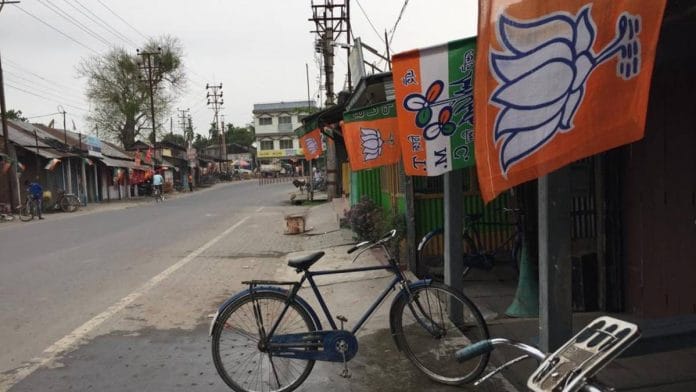
In the 2014 Parliamentary elections, BJP won only two out 42 seats in Bengal, and in 2016 state Assembly elections, only three out of 294 seats. But by campaigning heavily and outspending all other parties by a huge margin after that, it created a substantial base, becoming the second most important party in the state, behind only the TMC. It eclipsed both the CPI(M), which ruled Bengal for thirty four years (1977-2011), and the Congress party, which had a substantial presence in the state. The BJP won 18 parliamentary seats in 2019 and 77 seats in the 2021 assembly elections, capturing 38-40 per cent of state’s votes.
Why has the BJP focused so much on Bengal? In Hindu nationalist discourse, VD Savarkar is undoubtedly the largest ideological figure, but Bankim Chandra Chattopadhyay is viewed as the first Hindu nationalist and Vande Mataram the first Hindu nationalist song. Bankim’s ideologically germane work goes all the way back to the 1880s, roughly four decades before Savarkar’s Hindu nationalist writings were born. Moreover, Syama Prasad Mukherjee was the first President of the Bharatiya Jan Sangh, the predecessor of the BJP. According to the Hindu nationalist discourse, the first sprouts of Hindu nationalism appeared in Bengal.
But there is also an important contemporary reason. It has to do with the size of the Muslim electorate in Bengal. The state has the second largest proportion of Muslims in India. At nearly 30 per cent of the state population, it is second only to Assam’s 34 per cent. (It used to be third when Jammu and Kashmir was a state, where Muslims were a majority.)
For Hindu nationalists, the size of the Muslim electorate lends extraordinary significance to Bengal. If the BJP wins Bengal, it can only be because the Hindu community has been substantially unified around an anti-Muslim platform. Given how important the idea of Hindu unity is to Hindu nationalists, Bengal is one of the biggest prizes for the BJP’s ideological project. That is also why the Special Intensive Revision (SIR) is hugely significant. If the SIR can considerably reduce the number of Muslim voters, the odds of the BJP winning Bengal will go up. Mamata Banerjee’s popularity may not allow that to happen, but the motivation behind the SIR thrust should be manifestly clear.
The size of Muslim electorate is also substantial in Kerala—indeed, proportionately it is the third largest after Assam and Bengal. But religion is not the main driver of voting and politics in Kerala. In a state still heavily dominated by ideas of social justice, class and caste matter more, as religion plays a tertiary role. In Tamil Nadu, too, caste-based notions of social justice have dominated for decades, though their intensity has been going down for two reasons. First, politics have heavily diminished the political power of Brahmins. Second, having already achieved a big lower-caste revolution, Tamil Nadu has, of late, been rising as an economic powerhouse as successful industrialisation is transforming the state. New issues—infrastructure, investment, jobs in the formal sector—are beginning to enter political discourse. In Tamil Nadu, the BJP’s natural base is among the Brahmins, whose numbers are very small. It can’t be a big player unless it penetrates the lower castes, which constitute the base of the Dravidian parties. In Kerala, too, the BJP can at best finish as a third player trailing the two historically enduring coalitions, the Congress-led UDF and CPI(M)-led LDF.
Of the four states, the BJP’s best prospects are in Assam. It may have a chance in Bengal, but that is less probable. Its lowest performance will be in Kerala and Tamil Nadu.
But we should note that Bengal’s relevance is not simply confined to Indian politics. It’s of serious concern to democracy scholars and observers worldwide, who especially watch interventions like the SIR, now in full operation in Bengal (and spreading to other states as well). The theory of democratic backsliding, based on worldwide political experience, says that in contemporary times, the erosion of democracy begins with an attack on the non-electoral dimensions of democracy—freedom of expression, vibrancy of non-governmental civil society and minority rights—and the next target is typically the electoral process.
SIR can affect many low-income and low-literacy communities. Typically, they do not have access to the necessary documents. Their vote, despite documentary insufficiency, was earlier ensured by the state. The state would register them for voting, instead of assuming that such communities would step forward to register themselves. Once majoritarian ruling parties pursue such projects of voter registration, the effect on poorer minority communities is known to be highly disproportionate.
In sum, if the size of the Muslim electorate goes down sufficiently in Bengal and the BJP wins the state, it will not only be a matter of practical politics. Bengal’s political outcome will also enter the larger democratic discourse worldwide. Contrariwise, if the BJP loses in Bengal, it will also become clear that political parties can fight back by registering for vote those communities that are often targeted by such exclusionary projects.
(Edited by Theres Sudeep)

