



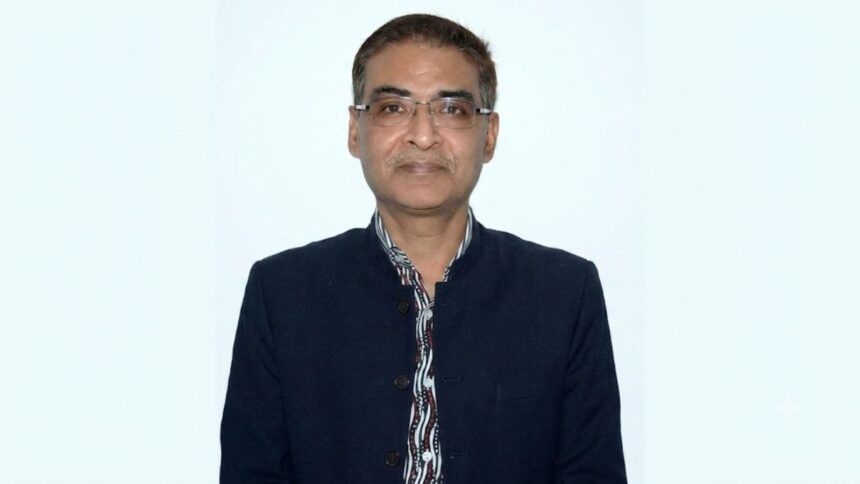
Rahul Singh, who was in the wake of glitches in testing of the Class 12 board exam papers, had an eventful two-year tenure on the job.
From introduction of the three-language policy, and recently its abrupt extension to Class 9, to learning in the mother tongue at the primary level, to the rolled out without a pilot in the Class 12 board exams this year, Singh oversaw several measures – often controversial – driven by the National Education Policy (NEP), 2020.
A 1996-batch IAS officer of the Bihar cadre, Singh took charge of the – the country’s largest national school board, with around 33,000 affiliated schools – in 2024, moving to the post from the Department of Personnel and Training. In August last year, Singh was given an extension till November 2027 by the Appointments Committee of the Cabinet.
Singh took over as head of the CBSE nearly a year after the release of the National Curriculum Framework for School Education, which is based on the NEP. This framework now guides the curriculum and structure of school education from pre-primary to Class 12, and Singh oversaw its implementation in the CBSE, through the extensive changes required for the same.
Last year, as part of this, the CBSE issued a circular asking schools to begin teaching students in the mother tongue or a “familiar regional language” from pre-primary to Class 5. While it did not make this compulsory, it suggested that the language of instruction should ideally be mother tongue, and if that’s not practical, it can be the state language.
The Board had earlier issued advisory circulars encouraging use of the mother tongue, but this was the first time that it set a timeline, asking schools to commence mother tongue-based instruction from July 2025 onwards.
Both the NEP and National Curriculum Framework recommend that mother tongue be used in primary school, up to the age of eight, since children learn concepts “most rapidly and deeply in their home language”.
The three-language policy was announced formally through the release of the CBSE’s curriculum in April this year, but the Board took the changes a step further. The National Curriculum Framework recommends that students learn three languages from Classes 6 to 10, unlike the current system where a third language is taught only till Class 8. The Board’s curriculum released in April made the third language compulsory starting from the Class 6 batch in the ongoing 2026-27 academic session onwards.
It also said that two of the three languages that students learn should be native to India. With English not being native to India, it becomes a ‘foreign’ language that schools now can choose at the cost of offering other foreign languages like French and German.
Again, in a volte-face in May, the CBSE said three languages would also be compulsory for Class 9 students in the ongoing academic session. When they move to Class 10, the three-language policy will continue, but with only an internal assessment and not a board exam in the same for now.
Under Singh, the CBSE also introduced the option of two board exams for Class 10 students from this year. This was in line with the NEP recommendation to ease the “high stakes” nature of a single board exam. So Class 10 students appearing for the CBSE exams this year had to mandatorily sit for the first set of board tests, and could choose whether they wanted to improve their performance in the second set or not.
But while he faced heat on many of these changes, Singh burnt his hands on the OSM system introduced for Class 12 board exams, with answer sheets marked digitally for the first time. Students spotted errors in marking, reported blurred answer scripts, and some said they received copies of answer sheets that were not theirs.
As the CBSE re-evaluation portal crashed due to heavy demand and saw payment issues, as the board could not get a new portal working fast enough, and as questions were raised over the firm chosen to introduce the OSM – all against the backdrop of the NEET paper leak – Singh’s position became more and more untenable.

