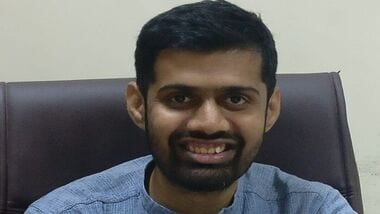
An speaking about the relevance of traditional Indian knowledge systems in an age increasingly shaped by artificial intelligence (AI), computer science and modern technology.
about IIT students, including those who performed well in the Joint Entrance Examination (JEE), approaching him to study Sanskrit and shastras, have attracted attention.
In a video shared on his X account, Prathosh questioned the conventional definition of success among students at premier technical institutions, arguing that education should extend beyond securing a high-paying job and accumulating material wealth.
“I’ll tell you what, some of my IIT students are studying shastra with me today,” he said.
His comments have also drawn attention for the connection he made between ancient Indian philosophical texts, intellectual reasoning and the ethical challenges posed by artificial intelligence.
A major reason behind the discussion is Prathosh’s argument that the study of shastras could complement modern scientific and technological education.
According to a report in India Today, he said some IIT students had approached him to understand why they should study Sanskrit and traditional Indian texts despite having pursued demanding technical courses.
According to the professor, studying these texts could help students develop intellectual abilities and question conventional ideas about success.
He argued that the purpose of education should not be limited to entering a prestigious institution, securing a lucrative job and acquiring material possessions.
Prathosh also connected the study of traditional texts with the development of artificial intelligence, arguing that technological progress needs to be accompanied by a deeper understanding of human values and responsibility.
Drawing an analogy with the Mahabharata, he reportedly suggested that algorithms should be designed to improve human life. He also questioned the consequences of placing powerful technologies in the hands of people without an understanding of dharma.
At the same time, he cautioned against approaching ancient Indian texts merely to search for references to modern scientific discoveries.
Using an agricultural analogy, he said: “You don’t cultivate the crop for the sake of weed; you cultivate the crop for the sake of crop.”
Prathosh outlined three dimensions of studying shastras: intellectual, social and metaphysical.
At the intellectual level, he argued that traditional Indian philosophical systems could help students develop structured reasoning, analytical thinking and the ability to examine arguments.
Citing Nyaya Shastra, an Indian philosophical tradition centred on logic, reasoning and methods of acquiring knowledge, he claimed that someone who had studied the subject for 12 years could be trained in quantum physics and mathematics within a year. He said he had conducted experiments to support this proposition.
At the social level, he connected the study of dharma with questions of responsibility, particularly in the context of emerging technologies.
At the metaphysical level, he referred to the Upanishads and their discussions on wealth, happiness and liberation. He cited the conversation between Yajnavalkya and Maitreyi in the Brihadaranyaka Upanishad, which examines whether material wealth can lead to immortality.
Academic profile:
-Faculty member, Department of Electrical Communication Engineering,
-Research areas: Machine learning, deep representation learning, AI and digital healthcare
-Co-founder of Cogniable and LatentForce.ai
Prathosh AP is an academic and artificial intelligence researcher at the . His research focuses on machine learning, deep representation learning, data-efficient learning and applications of AI in healthcare.
According to his academic profile, he received his PhD from in 2015, specialising in temporal data analysis. He completed his undergraduate engineering degree in 2011, three years before submitting his doctoral thesis.
After completing his doctorate, he worked at corporate research laboratories, including Xerox Research India and Philips Research, as well as a startup in California, the US.
His industry research, particularly in healthcare analytics, resulted in several intellectual property contributions. His profile lists 15 US patents, of which 10 were granted and six commercialised.
He joined the Indian Institute of Technology (IIT) Delhi in 2017 as an assistant professor in the Electrical Engineering department’s computer technology group. He worked there for four years before joining in September 2021.
He also co-founded Cogniable, a startup focused on developing learning algorithms for behavioural healthcare. The venture won first place in a Government of India AI startup challenge, according to his earlier IISc profile.
His current professional website also identifies him as co-founder and head of AI at LatentForce.ai, an AI venture incubated at IISc.
Prathosh’s academic work is primarily centred on artificial intelligence and machine learning.
His research interests include:
– Deep representation learning: Developing AI systems that can learn useful representations from complex data.
– Machine learning with limited data: Building models that can work effectively when training data is scarce.
– Deep generative models: Developing AI systems capable of generating new data and representations.
– Healthcare applications: Using machine learning and AI to address challenges in digital healthcare.
– Signal processing: Applying computational techniques to analyse and interpret signals.
His academic work combines theoretical research with practical applications, particularly in healthcare analytics and machine learning.