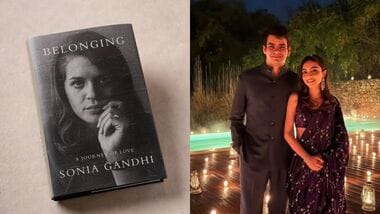
’s recently launched memoir, Belonging: A Journey of Love, is now out and hitting headlines for varied reasons. Featuring several unknown details about the Gandhis, her relationship and marriage to the former Prime Minister Rajiv Gandhi, personal struggles and more, the book highlights her addition to the Gandhi family and eventual political entry in India.
Amid mixed reactions, Sonia Gandhi’s book has a special contribution from Aviva Baig, who is the fiancée of Gandhi’s grandson . Aviva Baig and Raihan Vadra made their contributions towards the photographs in the book.
Sonia Gandhi’s memoir features a black-and-white photograph of herself at 20 on the front cover. The image was captured by Rajiv Gandhi in Turin, Italy, in 1966.
The back cover, meanwhile, features a more recent portrait of Sonia Gandhi. The picture was clicked in Delhi in 2026 by her grandson, Raihan Vadra and his fiancée, Aviva Baig.
The Congress Party chairperson’s latest picture offers a contrast to the younger version of her on the cover.
Taken almost 60 years apart, the two portraits bring together different chapters of Sonia Gandhi’s life.
hails from Delhi. She is a photographer and creative professional. Baig is the co-founder of Atelier 11, a photography studio and production company.
Aviva Baig got engaged to Raihan Vadra last year in December. The two dated for several years before making it official. Details about their upcoming wedding remains unknown.
Meanwhile, Raihan Vadra is the son of Congress leader Vadra and businessman Robert Vadra.
Raihan Vadra is a visual artist and photographer whose interest lies in wildlife, street and commercial subjects.
He helmed Sonia Gandhi’s cover shoot for Harper’s Bazaar India.
Recently, Raihan Vadra made news over his photography. He held a solo exhibition titled No Idea Is Final, at Delhi’s Bikaner House in October 2026, days after student protests.
The exhibition was said to feature over 100 photographs, including some covering student and youth protests in Delhi. However, hours before the opening of the exhibition, Vadra said that he was asked to remove or replace over 70 images. He claimed that the venue had objected to the political nature of his photographs.
However, Bikaner House responded by saying that those removed photographs were inconsistent as per exhibition policy.