



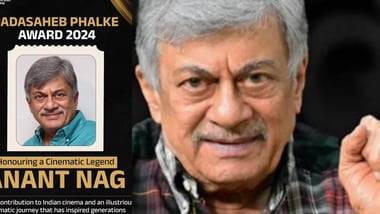
Veteran actor Anant Nag, who has worked extensively in Hindi and Kannada cinema, has been selected for the Dadasaheb Phalke Award for 2024. The government announced the honour on Wednesday.
Nag is known for his performances in films including “Minchina Ota”, “Hamsageethe”, “Ankur” and “Manthan”. Over a career spanning five decades, he has acted in more than 250 films across several languages. The 78-year-old actor has also made a mark in theatre.
The Dadasaheb Phalke Award is the highest honour in Indian cinema. Nag will receive it at the National ceremony in Kevadia, Gujarat, on September 22.
congratulated Nag on the honour and praised his contribution to Indian cinema.
“For several decades, his effortless performances, remarkable versatility and brilliance have left a very strong mark on Indian cinema, particularly Kannada cinema. In whichever role he has played, he brought rare depth and authenticity.”
In a post on X, Modi described the recognition as a “richly deserved honour for a truly distinguished artist”.
The Press Information Bureau (PIB) said the decision was taken following the recommendation of the Dadasaheb Phalke Award Selection Committee.
“On the recommendation of the Dadasaheb Phalke Award Selection Committee, the Government of India is pleased to announce that the Actor will be conferred the prestigious Dadasaheb Phalke Award 2024 for his contribution to Indian cinema and an illustrious cinematic journey that has inspired generations,” the PIB said in a release.
Last year, the award was given to Malayalam cinema Mohanlal. The 2024 award is being presented this year due to a delay in the schedule caused by the Covid-19 pandemic.
Nag has also been involved in politics and served as a minister in Karnataka. He grew up in a religious family in Bhatkal, coastal Karnataka, before being sent to Mumbai for higher education.
His early years in a math influenced his interest in stories and contributed to his later association with cinema and theatre.
While in Mumbai, Nag felt like a fish out of water but gradually became drawn to the theatre movement there. He started doing plays in Konkani, Hindi and Marathi for five years. There he met and was influenced by people like Satyadev Dubey, Girish Karnad and Amol Palekar.
Nag made his cinema debut with 1973 Kannada movie “Sankalpa” and gradually became an integral part of the parallel cinema there in the 1970s and 1980s.
He was a part of popular Doordashan serial “Malgudi Days”, the TV adaptation of R K Narayan’s popular work that was directed by Nag’s filmmaker brother, Shankar Nag.
Dubey introduced him to Shyam Benegal and then began a collaboration through six films, each one a classic. It began with the “Ankur”, also Nag’s first Hindi film, and “Nishant”, “Manthan”, “Bhumika”, “Kondura” and “Kalyug” followed. He is equally successful in the commercial Kannada cinema.
Nag’s portrayal as a disciple of Carnatic music in G B Iyer’s “Hamsageethe” in 1975 won him the National Film Award for Best Feature Film in Kannada.
The actor, a multi-faceted personality who is equally good as a singer and tabla player, became known for his natural acting at a time when stars actively cultivated certain mannerisms.
His major hits in Kannada include “Bayalu Daari”, “Na Ninna Bidalare”, “Chandanada Gombe”, “Aruna Raaga”, “Mududida Taavare Aralithu”, “Breaking News” and “Dashamukha”, “Godhi Banna Sadharana Mykattu” and “KGF”.
Nag, who was minister in Karnataka’s J H Patel government, has spoken about being influenced by JP movement at its peak. In 2004, Nag unsuccessfully contested the Chamarajpet constituency, Bangalore assembly election from Janata Dal (Secular).
Nag also introduced his brother Shankar Nag to cinema. Shankar acted, wrote, directed and produced many of the actor’s films until his death in a car crash in 1990 at the age of 35.
Last year, Nag was honoured with the Padma Bhushan.
First introduced in 1969, the awards are named after Dadasaheb Phalke, who is regarded as the father of Indian cinema with his 1913 movie “Raja Harishchandra”.
Malayalam cinema Mohanlal was the recipient last year.
(With inputs from PTI)