


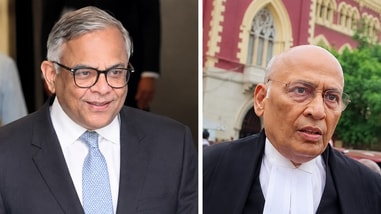
Senior Advocate Abhishek Manu Singhvi has emerged as one of the key legal figures in the escalating dispute between Tata Trusts and Tata Sons.
has appointed Singhvi to represent it in opposing the reappointment of N Chandrasekaran as chairman of and the proposed listing of the Tata group holding company.
The Trusts, which hold about 66% of Tata Sons, have challenged the validity of the September 17 board resolution reappointing Chandrasekaran for another five-year term.
Singhvi said he entered the dispute with “sadness and regret”, citing his association with the late .
His appointment is also notable because he was part of the Tata side’s legal team during the earlier Tata Sons-Cyrus Mistry dispute. He now represents Tata Trusts in a fresh battle over the governance and control of the group.
Singhvi is a Senior Advocate of the Supreme Court and a senior Congress politician. He is a member representing Telangana and has held several prominent parliamentary and organisational positions within the Congress.
Singhvi became the youngest Additional Solicitor General of India in 1997, at the age of 37, and served in the position from 1997 to 1998.
His father, Laxmi Mall Singhvi, was a noted jurist, diplomat and parliamentarian who served as India’s High Commissioner to the UK and was also a member of the Rajya Sabha.
Singhvi studied at St Columba’s School and St Stephen’s College, Delhi, where he completed a BA (Hons) in Economics. He later pursued postgraduate studies at Trinity College, Cambridge, where he obtained an MA and PhD.
He also attended a summer programme in Public International Law at Harvard University.
Singhvi’s current role in the Tata dispute is particularly notable because of his earlier involvement in the .
He was part of the legal team representing the Tata side after Mistry was removed as chairman of Tata Sons. The dispute eventually reached the Supreme Court, which in 2021 upheld the Tata Sons board’s decision to remove Mistry and examined the role and rights of the under Tata Sons’ Articles of Association.
Singhvi has represented senior Congress leaders, including Sonia Gandhi, in proceedings connected with the National Herald case involving Associated Journals Ltd (AJL) and Young Indian.
The case has involved proceedings by investigative agencies and legal challenges concerning the affairs of AJL and Young Indian, making Singhvi one of Congress’s prominent legal representatives in the matter.
Singhvi has also been associated with the long-running DK Basu litigation concerning custodial violence and human rights.
In subsequent proceedings in the case, the Supreme Court appointed Singhvi as amicus curiae. He made submissions seeking further directions and measures to strengthen safeguards against custodial abuse and improve the implementation of human rights protections.
The original DK Basu judgment remains a landmark ruling on safeguards against custodial torture and illegal detention.
Singhvi has represented the Animal Welfare Board of India in litigation concerning in 2017.
The Supreme Court proceedings involved questions around animal cruelty, the legality of the practice and subsequent legislation seeking to permit or regulate it.
Another notable case associated with Singhvi is Union of India v. Naveen Jindal, concerning citizens’ right to fly the national flag.
Singhvi appeared for Naveen Jindal before the Supreme Court. The court held that flying the national flag is protected as an aspect of freedom of expression under Article 19(1)(a), subject to reasonable restrictions.
Singhvi was also associated with some of India’s biggest telecom companies and major disputes that shaped the sector. Over the years, he represented companies including , and Idea Cellular in litigation involving issues such as spectrum charges, revenue-sharing arrangements, 3G intra-circle roaming agreements, licence renewals and the broader legal fallout from the 2G controversy.
Singhvi has also been a defence lawyer for leaders in the Delhi excise policy case.
He represented former Delhi Chief Minister Arvind Kejriwal and former Delhi Deputy Chief Minister Manish Sisodia in their challenge to the CBI’s arrest and their bail plea before the Supreme Court.
Singhvi represented Congress leader Rahul Gandhi in the criminal defamation case that led to his conviction and subsequent disqualification from the Lok Sabha in 2023.
The Supreme Court subsequently stayed Gandhi’s conviction, paving the way for the restoration of his parliamentary membership.
Singhvi has also been involved in major legal challenges concerning the Prevention of Money Laundering Act (PMLA) and its stringent bail provisions.
He has argued against the stringent “twin conditions” for bail under Section 45 of the PMLA and has challenged the law’s enforcement powers in major Supreme Court proceedings, including Vijay Madanlal Choudhary v. Union of India.