Pashmina, the ultra-fine fabric crafted from the natural undercoat of the Changthangi goat, has been for a very long time a distinct identity of Kashmir. Pashmina shawls, which have a feather-light and exceptionally soft feel, are created by seasoned artists, who spent a lifetime learning and perfecting the carft.
A single piece passes through 12 to 14 distinct manual processes across days before the fibers are turned into the famed .
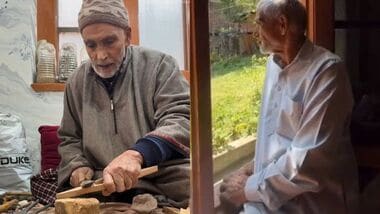
75-year-old Abdul Majeed Zargar from Amda Kadal Jogiwan, Srinagar, is not an artist making Pashmina shawls, but plays a key role in their creation. That is because he is one of the last Mukh craftsmen in the valley.
Locally called ‘Mukh’ the small wooden shuttles are an integral part of weaving Pashmina shawls and it is a craft that may soon be lost forever.
For nearly five decades, Zargar has been making Mukh, a small wooden shuttle that carries thread back and forth across a handloom.
According to Zargar, he stumbled upon the craft of making Mukh accidently as a teenager, trying to earn a living.
“I first started working with silver making and then turned to knife making. After trying my hand at both crafts, I realised neither skill worked for me,”Zargar told Kashmir Life in a recent interview.
According to Zargar, his initial days with Mukh weren’t promising, and he almost gave up on it.
“It took me almost a whole year to get my hands on the skill was exhausted and began to think that even this craft was not meant for me. I was about to leave this field,” he said.
The turning point, he said, came after he met a trader who bought and sold weaving tools in Khayam. The trader took him to a group of , who, despite pointing out the flaws of Zargar’s Mukhs, agreed to buy three pieces from him at ₹40 apiece.
According to Zargar, what he once sold at ₹40 now costs ₹1,800 and is one of the most essential tools in making Pashmina.
“It is the basis of Pashmina. If this is missing, cannot be made,” he said.
Today, many weavers use factory-made shuttle boats, which are cheaper and easier to find, leaving little to no room for craftsmen like Zargar, who spent a lifetime perfecting Mukhs.
“What matters is that the craft should continue,”Zargar said.
“I do not know what will happen after me,” he said. “But as long as I can hold my tools, I will keep making them.”