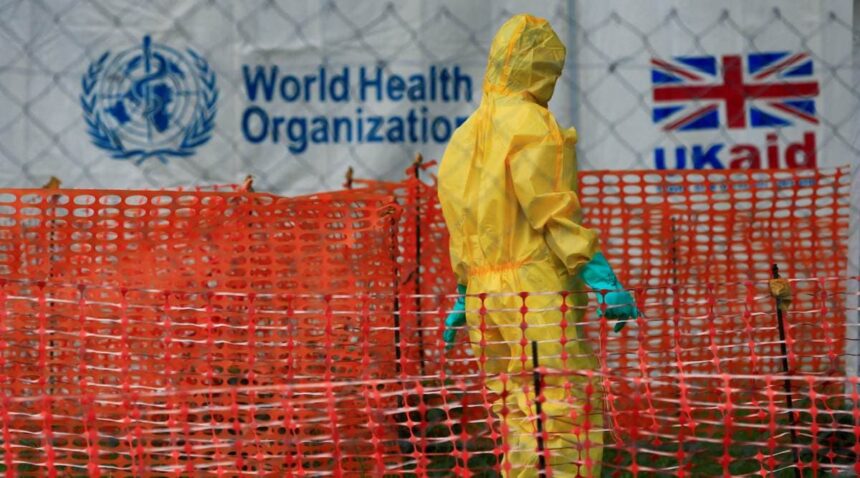
The World Health Organisation (WHO) has declared the Ebola outbreak in the Democratic Republic of the Congo (DRC) and Uganda a “Public Health Emergency of International Concern” (PHEIC), its highest level of global health alert, after the rare Bundibugyo strain of the virus spread across borders in East Africa.
According to the WHO, as of May 16, at least eight laboratory-confirmed Ebola cases, 246 suspected cases, and around 80 suspected deaths had been reported in eastern DRC, mainly in Ituri province. Uganda has also confirmed two Ebola cases, including one death, linked to travellers arriving from Congo.
More recent reports from Reuters and The Guardian said suspected cases had crossed 300, while the death toll was estimated at 88.
The Bundibugyo ebolavirus causes the current outbreak; a rarer strain of Ebola first identified in Uganda in 2007. Unlike the more common Zaire strain, there are currently no approved vaccines or targeted treatments specifically designed for Bundibugyo Ebola.
Health experts say the absence of vaccines and the spread into densely populated areas such as Kampala and Goma have heightened fears of wider regional transmission.
WHO said the outbreak met the threshold for a PHEIC because of:
The WHO also warned that surveillance gaps and insecurity in rebel-controlled regions could mean the real number of infections is much higher than officially reported.
and can cause fever, vomiting, diarrhoea, internal bleeding and organ failure. Depending on the strain and medical response, fatality rates can range between 25% and 90%.
The Bundibugyo strain has historically shown a fatality rate of roughly 25–50%, according to previous WHO outbreak data.
According to Reuters, the WHO, Africa CDC, and the US Centers for Disease Control and Prevention (CDC) have activated emergency response mechanisms. Additional medical teams, testing support, contact tracing operations and border surveillance measures are being deployed in both countries.
The US CDC has also begun assisting some Americans who may have been exposed to the virus in Congo.
No. WHO has clarified that the outbreak is not currently considered a pandemic-level global emergency like , but it poses a serious regional and international public health threat requiring coordinated action.