



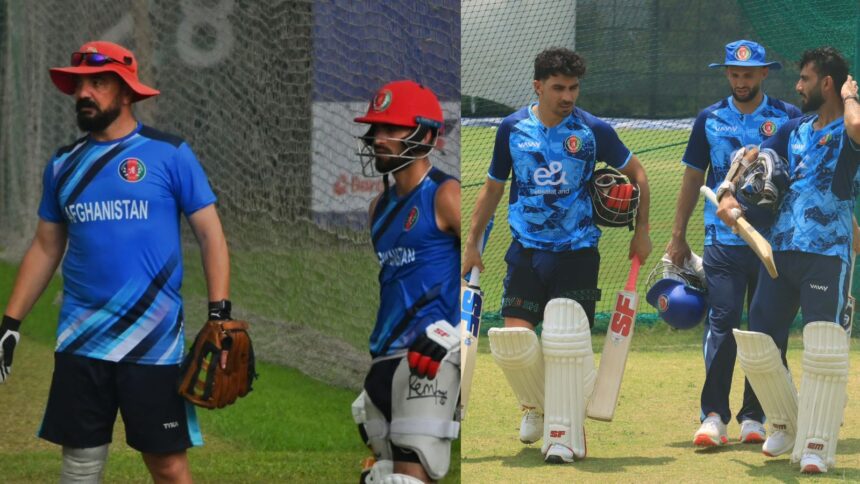
Rais Ahmadzai remembers a “long, long drive” with his young Afghan teammates in Zimbabwe from well over a decade ago, as if it were yesterday.
It was August 2009. Hopping on what he now recollects was a small van, Ahmadzai and the Afghanistan cricket team were travelling 250 kilometres from Harare, chasing history. Nerves jangling, they were approaching something they had never really prepared for before — all-white kits, a red cricket ball, and the status of First-Class cricketers awaiting at the Mutare Sports Club.
“I was so excited to wear a white kit, to have the white floppy on my head,” Ahmadzai, now head coach of the Afghanistan A and U-19 teams, tells The Indian Express from Kabul.
“I remember us talking in the van… that at the end of the match, our cricket profiles on the internet would recognise us as First-Class cricketers,” he recounts.
Novices in the longer format, walked away with a draw against a stronger Zimbabwe XI, though Ahmadzai now scoffs at their unlettered approach on debut. “We had no idea how to play the red ball. There was no temperament. Everyone was in a hurry.”
Five months after that Zimbabwean initiation, Afghanistan won the ICC Intercontinental Cup – an erstwhile First-Class development tournament – at the first time of asking, beating Scotland in the final. The first batch of Test caps arrived in under 10 years when Asghar Afghan’s men took the field against India in in 2018.
On Saturday, Hashmatullah Shahidi’s side will contest Afghanistan’s second Test against India at the PCA Stadium in New . Ahmadzai traces a discernible contrast between sides from back in his time and now. “Match fees, contracts, good facilities, a clinical approach to batting and bowling in red-ball cricket.”
If basic facilities were scarce 17 years ago, the lack of structured game time continues to hinder Afghanistan’s cricket story across formats.
“We have more experience now. But we need to play more Tests. We play only one or two per year,” skipper Shahidi said in the pre-match press conference on Thursday.
Having played only 12 in eight years hasn’t helped. Afghanistan are considered giant-killers in the white-ball formats, reaching the 2024 T20 World Cup semifinals and coming close to the same stage at the ODI World Cup a few months earlier. But as far as Tests are concerned, even their early success – four wins in 12 matches – has been overlooked.
“We remain among one of the few teams to have won in just their second-ever Test appearance. For a team that hardly plays a Test or two a year, four wins are a significant achievement. The real test will begin when we get to play six to eight matches a year,” says Ahmadzai.
White-ball success and the emergence of global franchise league stars such as , and Rahmanullah Gurbaz have paved the way for Afghanistan’s red-ball aspirations.
Cricket grounds in Jalalabad and Nangarhar, 150 kilometres from the capital Kabul, have gained prominence in hosting the Ahmad Shah Abdali tournament – the annual First-Class event in the country.
“We have a very strong First-Class structure. Good players from the age-groups are being picked to play in the tournament that is now contested by four teams,” Ahmadzai informs.
The glare of T20 cricket that lifts players from obscurity is inescapable, but Ahmadzai stresses that the national board is steadily backing the development of cricketers proficient in the longest format.
“Most of the players hail from very poor families. Because of what T20s have done for some of them, everyone now wants to participate in such leagues. As a Test-playing nation, we must also be able to provide the players with good contracts and inform the selection committees that a good Test cricketer will be able to contribute to other formats as well.”
But Afghanistan has to fight for recognition during diminishing red-ball international windows outside the World Test Championship cycle, at a time when even India are navigating a slow-paced Test transition under .
Hope and a wave of names float for Afghanistan from the month-long camp for Test players in Kabul and subsequent three-day matches in Jalalabad.
“I am excited by the way Sediqullah Atal and Rahmanullah Zadran played in the practice games in preparation for the India tour,” says Ahmadzai, counting on the young batters to leave an impression.
A strong showing against the two-time WTC finalists could impress the ICC board this week, but pathways for a structured Test cricket calendar still demand more work.
“The quality of home pitches needs to improve. But if we want to work more, the Test in India will be a good challenge,” says Ahmadzai. “We will be waiting for the next ICC meeting to see how many Tests they will give us in the new cycle.”
A van ride to Mutare had set the red-ball rolling in Afghanistan 17 years ago. The frontier has shifted by a few yards, from a fight for admission to taking on the big boys for regular time on the Test cricket roster.

