



Written by: Gitika Sharma
Sunita Rawat had no idea she was sewing a ghost.
A homemaker in her 40s from Punjab, self-taught with a needle and thread after a tailor once quoted her more than she could afford, was scrolling through Pinterest the way she always does, looking for something beautiful to make. She found it: an elaborate gown, detailed and dreamy. She studied it, sourced leftover fabric scraps from her elder daughter’s fashion work, and spent the better part of ten days bringing it to life, stitch by careful stitch, between her household chores.
The dress was stunning. The original image, it turned out, had never existed in the physical world. It was AI-generated.
“I had no idea it was AI,” Sunita says. “I just liked the design and thought about it and made it. I will try to make any dress I like, be it AI or not. I just want to bring out the design in its truest sense.”
Her daughter Shalu, a 19-year-old content creator, posted the video of her mother’s creation. It spread quickly, not merely as a feel-good moment, but as an almost perfect illustration of something larger quietly happening across fashion: the dissolving boundary between the imagined and the made.
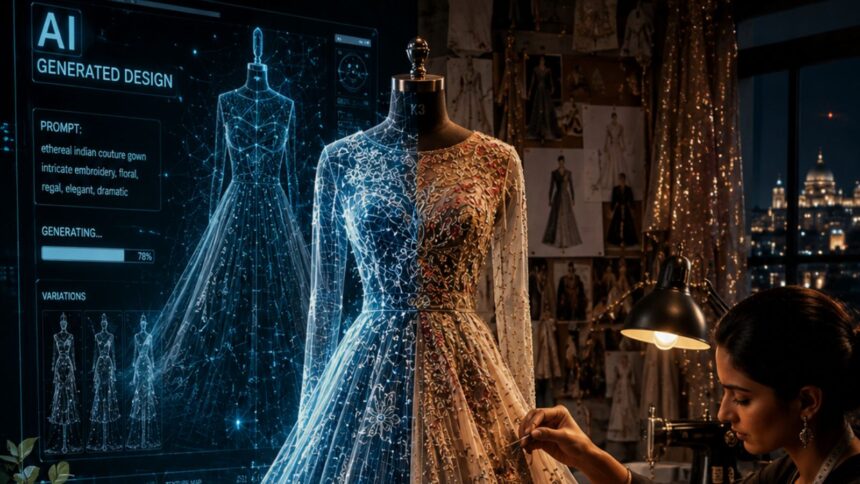
For -based fashion designer Afsha Noor, who goes by Noor Alchemy on Instagram and creates AI-generated couture and bridal collections, this dissolving line is not a side effect. It is the entire point.
“You cannot come inside my head and see what I am imagining,” she says. “What we are doing with AI is imagining out loud.”
Noor uses AI at every stage of her process, from concept sketching to presenting finished looks to clients, and says the results have changed how buyers engage with her work. “Till date, whatever clients I have are not able to differentiate between what is real and what is AI. They are able to see what the actual outfit will look like. And this makes them feel confident in placing an order.”
She is emphatic, though, that AI is not the author of her vision. “We treat AI as an assistant. You have a vision, and AI is just helping you. That is it.” Her creative instinct comes first, always, and the technology follows.
This distinction matters enormously to Vijay Raj, a visualiser and branding expert based in Kochi with over a decade in advertising, who has watched AI reshape the industry from the inside.
“My workflow is that when I get a concept or a brief, I think it through by myself first. After that process, I use AI only for prompting,” he explains. “Otherwise, we are not controlling something; the AI is completely controlling us.”
Raj is both an enthusiast and a watchdog. In workshops he conducts at universities, he tells students plainly: “You are completely free to generate anything you want, but as a designer, you have a value to your society and a responsibility to it.” He argues that fashion shares the same ecosystem of trust and misinformation as any other part of society, and designers must take that seriously.
Luxury label founder Ranna Gill, trained at FIT New York and a veteran of Donna Karan and Ralph Lauren, sees AI with the measured pragmatism of someone who has watched several revolutions come through the industry. Her studio uses it for early visualization, testing how a colour, print, or embroidery might look before committing to samples, but she is clear about its limits.
“AI generates designs, but we still have to recreate it. We rework on it, reposition it, colour it. It is not the final draft,” she says. She draws a longer arc: “When the computer was invented, we learned to use it. We learned to use smartphones. And as we will learn to use AI, we will bring it into our worlds in the ways best for us.”
Couture designer Ridhi Mehra, known for blending traditional Indian craft with contemporary silhouettes, echoes this measured view. AI has made the client conversation easier, she says, because brides can now visualize a garment before it is made, but it has also introduced a new anxiety. “The distinctiveness is definitely getting lost. Now anybody can pick up from anywhere, put it on AI, and create whatever they want.”
On the production side, fabric sourcing professional Harish Sharma watches all of this with the pragmatism of someone who must make the imagined physical. “AI creates designs digitally, but we have to make them practical in real life. There is a big difference between designing on a computer and producing it in reality. Every fabric has its own behaviour. It is not as easy as it looks,” he says.
Back in Punjab, Sunita Rawat does not particularly care about any of this debate. She sees an image she likes, and she builds it. The future of fashion, it turns out, may rest in both the most sophisticated algorithm and the most human instinct: the desire to make something beautiful real.
(The author is an intern with The Indian Express)



