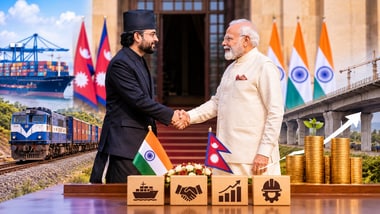
India and Nepal have agreed to deepen their economic and strategic partnership, with Prime Minister Narendra Modi announcing a development assistance package worth ₹15,000 crore (NPR 24,000 crore) for Nepal during talks with his Nepalese counterpart, Balendra Shah, in New Delhi on Monday.
The announcement came as the two countries signed eight agreements and adopted a joint vision document outlining a roadmap for cooperation across trade, infrastructure, energy, connectivity, technology and other sectors.
The meeting also marked an important diplomatic moment, with Shah choosing India for his first bilateral foreign visit since taking office in March.
The renewed push for cooperation comes against the backdrop of recent strains in bilateral relations, particularly over the long-standing boundary dispute involving Lipulekh, Kalapani and Limpiyadhura.
Here’s what is inside India’s ₹15,000-crore package and what the Modi-Balen Shah meeting means for bilateral trade, investment and infrastructure.
The ₹15,000-crore development assistance package, equivalent to NPR 24,000 crore, comprises two major components: grant assistance and a Line of Credit.
According to the announcement, India will provide NPR 5,600 crore (approximately ₹3,500 crore) in grants for post-earthquake reconstruction and new infrastructure projects in .
The remaining NPR 18,400 crore (approximately ₹11,500 crore) will be extended through a Line of Credit to support projects in the energy sector.
The assistance is aimed at supporting Nepal’s reconstruction efforts, strengthening infrastructure and creating long-term economic opportunities.
PM Modi also underlined India’s commitment to helping Nepal recover from the devastating floods that struck the country in August.
The two leaders said cooperation would focus on restoring affected communities, strengthening disaster preparedness and improving capacity to deal with future natural disasters.
India and Nepal signed eight agreements covering several areas, including forensic sciences, healthcare, sustainable urban development and fisheries.
The two countries also adopted a joint vision document titled ‘Viksit Bharat and Samunnat Nepal: Re-imagining the Partnership’. It seeks to give a fresh direction to bilateral engagement by expanding traditional areas of cooperation while identifying new opportunities in emerging sectors.
The framework covers economic and development partnerships, energy, water resources, connectivity, climate resilience, disaster management, sports, start-ups, digital services, space and innovation.
The two governments also agreed to establish an offshore campus of the Indian Institute of Technology () in Nepal, alongside a start-up incubator and an innovation hub.
One of the significant announcements from the meeting was India’s decision to provide Nepal with an additional route for its transit trade through Deendayal Port at Kandla in Gujarat.
Nepal will also gain access to Paradip Port once the necessary infrastructure is in place.
The move is expected to expand Nepal’s access to maritime trade routes and provide additional options for handling its international cargo.
The two prime ministers also stressed the need to strengthen cross-border connectivity through new railway lines, bridges, Integrated Check Posts (ICPs) and petroleum pipelines.
They virtually laid the foundation stone for a new ICP at Banbasa and welcomed progress on similar facilities at Bhairahawa, Sunauli and Dodhara-Chandani.
A new motorable bridge connecting Dharchula in India with Darchula in Nepal was also inaugurated virtually.
Modi and Shah flagged off the inaugural Sarayu-Kamala Express rail service connecting in Uttar Pradesh with Janakpur in Nepal.
The service is expected to improve cross-border passenger connectivity while giving a boost to religious and cultural tourism along the Ramayana Circuit.
Both countries also agreed to explore similar connectivity projects to develop Buddhist and Shiv-Shakti religious tourism circuits.
The initiative builds on the historical and cultural links between the two countries and seeks to translate these ties into greater tourism and economic activity.
Energy emerged as another major pillar of the discussions, with both sides agreeing to accelerate cooperation in petroleum infrastructure and hydropower development.
The leaders dedicated Phase II of the Motihari-Amlekhgunj petroleum pipeline to the people of . They also laid the foundation stone for a petroleum terminal in Jhapa and emphasised the early commencement of work on the Siliguri-Jhapa petroleum pipeline.
India and Nepal will also explore cooperation on
In the hydropower sector, the two sides welcomed the participation of Indian companies in Nepal’s energy projects and agreed to expedite their completion.
The foundation stone for the 669-megawatt Lower Arun Hydroelectric Project was also laid virtually.
The developments build on the two countries’ existing power-sector cooperation and long-term electricity trade arrangements.
Despite the renewed push for economic cooperation, the long-standing boundary dispute remains an important issue in bilateral relations.
The disagreement centres on , Kalapani and Limpiyadhura. India maintains that these territories are part of Uttarakhand.
Relations had come under strain in May after Shah called for the involvement of and the United Kingdom in resolving the dispute.
New Delhi subsequently rejected any role for third parties, maintaining that the issue should be addressed through established bilateral mechanisms.
During Monday’s meeting, the two prime ministers acknowledged progress in joint fieldwork relating to the maintenance and repair of boundary pillars.
They also directed their respective foreign secretaries to work on the outstanding boundary issues.
Shah’s first bilateral foreign visit to India carries significance at a time when New Delhi is looking to strengthen its neighbourhood partnerships and reinforce economic engagement with .
The ₹15,000-crore package, new port access, cross-border infrastructure projects and energy investments underline India’s effort to deepen its economic presence in .
For Nepal, the agreements offer opportunities to attract investment, improve access to trade routes, expand energy infrastructure and strengthen connectivity with its largest neighbour.
described the relationship as one rooted in shared history, trust and people-to-people connections, while Shah said the two countries must build a development partnership based on mutual respect and shared prosperity.
With inputs from PTI.