



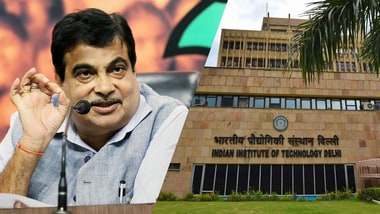
A low-cost device developed from an IIT-Delhi innovation could soon offer India’s ageing diesel trucks and buses a new lease of life — while cutting some of their most harmful emissions by as much as 90%.
Union Road Transport and Highways Minister Nitin Gadkari has announced that the government is preparing to allow older and heavily polluting diesel vehicles to be fitted with retrofit emission control devices, or RECDs, instead of relying only on scrappage and replacement
The technology is expected to cost around ₹4,000 to ₹5,000 per vehicle.
That price point is central to the government’s plan. Replacing an ageing truck or bus with a newer vehicle is a major financial decision for fleet owners. Retrofitting, by contrast, could offer a considerably cheaper route to cleaner emissions for vehicles that remain operational but fall short of the stricter standards.
According to , the device can reduce particulate matter emissions by up to 90% and nitrogen oxide emissions by 60%. It can be fitted to BS-III, BS-IV and other older diesel vehicles, with tests showing that emissions from retrofitted vehicles can be brought closer to levels comparable with BS-VI vehicles.
The device works as an additional emission control system fitted to an existing vehicle, rather than requiring the replacement of its engine. The broader principle is not entirely new.
Similar retrofit emission control technology has already been deployed on diesel generator sets, where exhaust treatment systems are used to reduce harmful particulate pollution. The has maintained a list of certified RECD technologies for diesel generator engines, demonstrating that retrofit-based pollution control is already an established approach in India.
The challenge with older diesel vehicles is particularly significant because Bharat Stage-VI norms, which took effect in 2020, imposed far stricter limits on vehicular emissions than previous generations of standards. A Delhi Assembly pollution report has noted that bringing older BS-IV diesel engines closer to BS-VI levels generally requires technologies capable of controlling both particulate matter and nitrogen oxides, including particulate filters and NOx-treatment systems.
Gadkari announced the proposed rollout at an event organised by the Society of Indian Automobile Manufacturers, saying the-linked technology had completed testing successfully.
The government is now preparing the regulatory framework for its wider use. The road transport ministry is expected to move ahead with Automotive Industry Standard 228, which will set the technical specifications and performance requirements for retrofit emission-control devices before their commercial deployment.
The scheme is intended to supplement, rather than replace, India’s existing vehicle scrappage policy.
That distinction matters. Old, highly polluting vehicles that are no longer viable may still have to be taken off the road. But trucks and buses that remain in service could potentially be cleaned up at a fraction of the cost of purchasing replacements.
At the same event, Gadkari widened the discussion to India’s broader transport and road-safety challenges. He said the country had only about two buses per 1,000 people, compared with a global benchmark of eight, and called for more innovative public transport systems in Tier-II, Tier-III and smaller cities.
The minister also said Bharat NCAP 2 would be introduced from October 2027, expanding vehicle safety assessments to examine the wider safety chain rather than focusing narrowly on individual crash-test outcomes. India continues to face an acute road safety crisis, with Gadkari citing around five lakh accidents and 1.8 lakh deaths annually.
For now, however, the ₹5,000 retrofit device represents a different kind of intervention: an attempt to tackle not by waiting for India’s old diesel fleet to disappear, but by making the vehicles already on its roads significantly cleaner.