



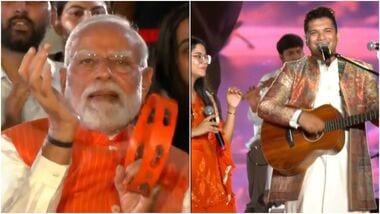
attended a ‘Bhajan Clubbing’ programme at Deen Dayal Upadhyay Park in Delhi on Friday, 25 September, to mark the 110th birth anniversary of Bharatiya Jana Sangh leader Pandit Deendayal Upadhyaya.
Modi was seen listening to devotional songs at the event, clapping along and playing a tambourine as performers led the gathering.
The programme brought a newer format of devotional music into the spotlight, with large groups coming together to sing and engage with bhajans in a setting more closely associated with a concert than a traditional prayer gathering.
‘Bhajan Clubbing’ refers to devotional music events that retain traditional bhajans while presenting them through a modern, high-energy format. Performances can include amplified music, guitars, drums, electronic beats, stage lighting and large-scale production, while the lyrics remain rooted in devotional songs.
The format has increasingly attracted younger audiences, including . Events are generally positioned as alcohol- and drug-free gatherings where people can sing, dance, clap and participate in devotional music in a social setting.
Reports on the trend have described it as a meeting point between traditional religious music and contemporary .
The idea is not entirely new. Devotional singing has long been part of temples, community gatherings and religious celebrations, but organisers and performers have increasingly adapted its presentation for younger audiences and larger venues. Some events now resemble music concerts, complete with stage lighting and rock or electronic arrangements.
Bhajan clubbing has emerged as a visible cultural trend in several cities, with events attracting both younger participants and families.
Organisers have presented it as a way of connecting traditional devotional music with contemporary audiences without changing the religious songs themselves.
Modi had already spoken about the trend during an episode of his monthly radio programme in January 2026. He described bhajan clubbing as a combination of devotion, culture, and modernity, and said such gatherings had found resonance among young people. He also said the events could resemble global concerts while retaining the sanctity of bhajans.
The format has also prompted debate about how religious traditions are being adapted for modern entertainment spaces. Supporters see it as a new way of engaging younger audiences with devotional music, while some critics have questioned the and changing presentation of religious practices.
Friday’s programme was organised on the birth anniversary of Deendayal Upadhyaya, a prominent leader of the Bharatiya Jana Sangh, the political organisation that preceded the .
Upadhyaya is associated with the philosophy of Antyodaya, which emphasises the upliftment and welfare of the poorest and most marginalised sections of society. The event therefore brought together a commemorative occasion and a contemporary devotional music format that has gained visibility in recent months.