



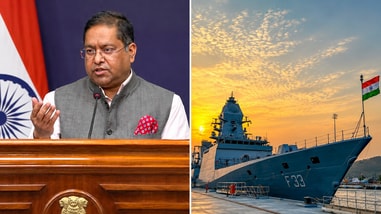
India on Wednesday lodged a strong protest with Pakistan over the “unacceptable and unprofessional conduct” of a Pakistani naval vessel that collided with an Indian Navy warship in the North Arabian Sea.
The Ministry of External Affairs (MEA) said in a statement that Charge d’Affaires Saad Warraich was summoned to the ministry and informed of India’s concerns.
The said the incident took place in international waters and did not cause any major damage.
India said the Pakistani vessel manoeuvred in an “unsafe and unprofessional manner”, leading to the collision.
New Delhi has specifically cited Article 10 of the April 1991 Agreement between India and Pakistan on Advance Notice on , Manoeuvres and Troop Movements, saying the conduct of the Pakistani naval ship was in “direct contravention” of the provision.
The agreement was signed in April 1991 as a confidence-building measure between India and .
Its broader purpose was to reduce the risk of military activities being misinterpreted and to establish rules and advance-notice mechanisms for military exercises, manoeuvres and troop movements.
While much of the agreement concerns military exercises and movements, it also includes provisions to prevent dangerous encounters between military platforms.
The key provision in the current dispute is Article 10, which specifically deals with naval ships and submarines operating in international waters.
It states: “The Naval ships and submarines belonging to the other country are not to close less than three Nautical Miles (NMs) from each other so as to avoid any accident while operating in international waters.”
The provision requires naval ships and submarines belonging to India and Pakistan to maintain a minimum separation of three nautical miles — roughly 5.56 kilometres — from each other while operating in international waters.
The incident occurred on the evening of September 15, when an Indian Navy warship was carrying out a routine surveillance mission in the North Arabian Sea, Hindustan Times reported.
The Pakistani vessel reportedly approached at high speed and manoeuvred in a manner India considered unsafe.
The said the Pakistani Charge d’Affaires was advised to convey to the relevant authorities the need for all military units to exercise due care and comply with the provisions of existing agreements between India and Pakistan to prevent a recurrence.
India has also instructed its Charge d’Affaires in Islamabad to lodge a similar protest with Pakistan’s Ministry of Foreign Affairs.
Article 10 is essentially a collision-avoidance and confidence-building provision.
The three-nautical-mile requirement creates a defined buffer between Indian and Pakistani naval vessels operating in international waters.
Given the rising tensions between the two nations, the idea is to prevent close encounters from escalating into accidents or more serious confrontations that could lead to a military conflict.
This becomes particularly significant when naval vessels are operating in the same maritime area.
This is not the first India-Pakistan naval incident involving Article 10
On June 16, 2011, warship INS Godavari and Pakistan Navy vessel PNS Babur came into contact in the Gulf of Aden while both were involved in operations surrounding the merchant vessel MV Suez, which had been released after being held by Somali pirates.
According to India’s , INS Godavari had approached MV Suez to establish communication and check on the safety of its crew.
The two vessels made contact, causing marginal damage to the safety net on Godavari’s helicopter deck.
India subsequently lodged a formal protest, citing both the International Regulations for Preventing Collisions at Sea and Article 10 of the 1991 India-Pakistan agreement.