



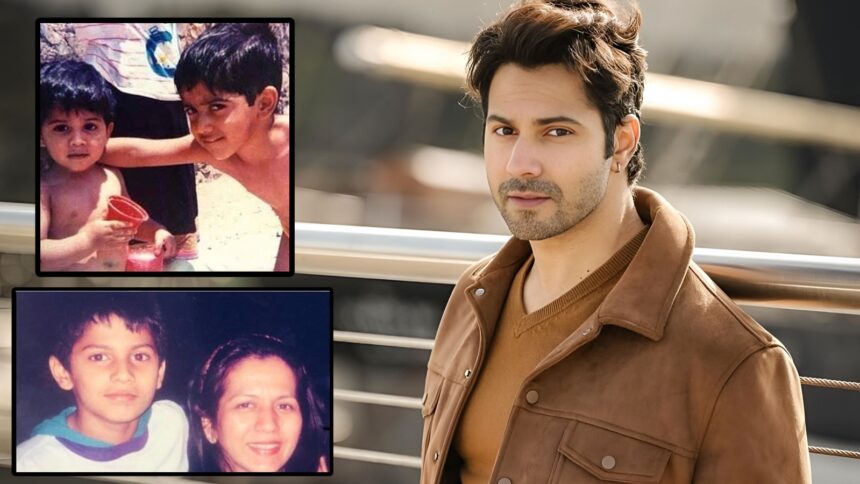
Many people have their own share of quirks as a child, but Varun Dhawan’s unusual core memory might leave you surprised. Speaking on the Be A Man, Yaar! podcast with Nikhil Taneja, Dhawan reflected on his childhood, calling it more magical than his adulthood.
“Bachpan mera unbelievable tha. Meri jawani se better mera bachpan tha,” (my childhood was better than adulthood), he said, adding that he was deeply immersed in imagination. “I think I was a lot into stories and dreaming. Imagination mera bahut wild tha. Kahi na mai ek lalaland me jeeta tha, I was living in a Varun world.”
DISCLAIMER:
But what stood out was his candid confession about how he dealt with emotions — especially sadness.
“Tab main jab rota tha, main itna filmy bachcha tha, main mirror mein jaake rota tha kyunki mujhe dekhna tha ki main kaise lag raha hoon rote hue. To mai jaake rota tha… fir mai rota tha aur mai ruk jata tha, fir mai dekhta tha ki nahi yaar ye achcha nahi lagra thoda sa.”
(“I was such a filmy kid that I would go and cry in front of the mirror because I wanted to see how I looked while crying… I would stop and look at myself and think, ‘No yaar, this doesn’t look that good.)
According to Dr Abhinit Kumar, Senior Consultant, Psychiatry, ShardaCare – Healthcity, this behaviour is actually a powerful psychological marker.
“A child who sees himself in a mirror crying has just found out something wonderful, that he is something that can be seen. That awareness is a real developmental milestone, and the interest they show in their own crying face is one of the first types of self-reflection that we are aware of.”
In simple terms, it’s the beginning of self-awareness — the moment a child realises they can observe themselves, not just feel.
What’s even more interesting is what Dhawan described next — stopping mid-cry and evaluating how he looked.
“When a child ceases crying upon seeing his or her reflection, nearly self-correcting, he or she is already doing what adults take years of therapy to learn,” Dr Kumar explains.
“They are witnessing a feeling and not being overwhelmed by it. That little stop is the basis of emotional control.”
That instinctive pause — even if it comes from something as simple as looking in the mirror — is actually the foundation of emotional regulation.
This behaviour isn’t limited to children. Adults, too, sometimes look at themselves while emotional — and there’s a reason for it. “The mirror creates distance. It transforms a subjective experience into an objective one, and this makes it easier to handle,” says Dr Kumar.
“It is not unhealthy in any way, and in clinical terms, being able to observe your own emotional state without being overwhelmed by it is in fact a sign of psychological health.” In other words, stepping “outside” your emotions — even briefly — can help you manage them better.
“The ability to view your own distress with a certain lightness is, in my experience, one of the more subtle indicators of resilience,” the psychiatrist concludes.
Varun Dhawan has been trending on Google for the past 24 hours
DISCLAIMER:

