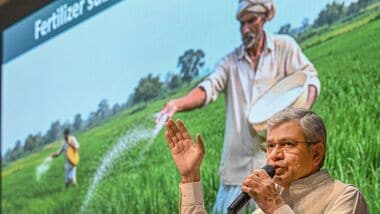
NEW DELHI: The Centre has approved a 64% year-on-year increase in fertilizer subsidies for the ongoing rabi season to ₹62,370 crore, as it seeks to keep farm input costs affordable amid volatile global prices. The move, however, could put pressure on the Centre’s fertilizer budget for fiscal year 2027 (FY27), potentially requiring additional funds.
The increase comes after rice acreage declined 3.46% year-on-year during the 2026 kharif season and ahead of the next sowing cycle, when wheat, pulses and oilseeds are the key crops.
Announcing the decisions taken at Wednesday’s Union Cabinet meeting, information and broadcasting minister Ashwini Vaishnaw said India had fertilizer stocks of about 23.5 million tonnes, against a requirement of 35 million tonnes for this rabi season. The higher subsidy, he said, was intended to ensure adequate supplies of essential soil nutrients at affordable prices for farmers.
The Cabinet approved a total outlay of ₹77,101 crore across several measures, including fertilizer subsidies, credit guarantees for micro enterprises and disadvantaged entrepreneurs, a museum in New Delhi and an extension of the Noida Metro.
The biggest component is ₹62,370 crore under the Nutrient Based Subsidy (NBS) scheme for phosphatic and potassic (P&K) fertilizers during the rabi 2026-27 season. This compares with a budgetary requirement of ₹37,952 crore for the previous rabi season.
The higher requirement could put pressure on the Centre’s fertilizer subsidy budget. Against the FY27 NBS allocation of ₹54,000 crore, the government had spent ₹33,664 crore by September-end, leaving ₹20,336 crore. The newly approved seasonal requirement is therefore about ₹42,034 crore higher than the remaining provision, potentially necessitating additional budgetary support.
The higher subsidy comes amid volatility in international fertilizer and input prices, including di-ammonium phosphate (DAP), muriate of potash (MOP) and sulphur. The government has retained special provisions to ensure DAP is available to farmers at ₹1,350 per 50-kg bag, over and above the NBS subsidy.
The approved NBS rates for the four nutrients are ₹94.21 per kg for nitrogen, ₹66.11 for phosphorus, ₹2.38 for potash and ₹10.42 for sulphur. The rates will apply from 1 October 2026 to 31 March 2027.
The package also includes a support mechanism for domestic manufacturers of sulphur-based fertilizers. Under it, manufacturers will receive 20% of the actual procurement cost, subject to a floor price of $800 per tonne for sulphur and $266.67 per tonne for sulphuric acid, Vaishnaw said.
“The revision in NBS rates for rabi 2026-27, along with the various support measures undertaken during the year, demonstrates the government’s strong commitment to protecting farmers from volatility in global fertilizer and raw material markets. It will help ensure adequate availability of P&K fertilizers at affordable prices, promote balanced plant nutrition and provide an important impetus to domestic production,” said S. Sankarasubramanian, chairman, Fertiliser Association of India (FAI).
Government data show that total fertilizer stocks stood at 23.52 million tonnes on 10 November, against 17.35 million tonnes a year earlier. Urea stocks rose to 10.31 million tonnes from 7.21 million tonnes, while DAP stocks increased to 2.86 million tonnes from 2.48 million tonnes. NPK stocks climbed to 6.08 million tonnes from 4.24 million tonnes.
The Union cabinet approved the continuation of two credit guarantee schemes aimed at expanding access to finance.
The Credit Guarantee Fund for Micro Units (CGFMU) will continue for five years until 31 March 2031, with a corpus of ₹5,000 crore. The scheme provides guarantees to lending institutions against defaults on eligible loans extended under the Pradhan Mantri Mudra Yojana (PMMY).
The guarantee will cover Mudra loans of up to ₹20 lakh, overdrafts of up to ₹10,000 under the Pradhan Mantri Jan Dhan Yojana and eligible self-help group loans. The annual guarantee fee for Mudra loans has been reduced from 1% to 0.75%, Vaishnaw said.
The Cabinet also approved the continuation of the Stand-Up India scheme until March 2031, with a credit guarantee corpus of ₹4,111 crore. The scheme aims to extend financial assistance to an additional 2.5 lakh entrepreneurs from among women and Scheduled Castes and Scheduled Tribes.
Separately, ₹3,230 crore was approved for developing the Yuge Yugeen Bharat Museum in the historic North and South Block complexes in New Delhi. The project will repurpose the buildings, preserving their architectural character while converting them into a national cultural institution. It is expected to be completed over three years, the minister said.
The government expects the museum to accommodate 30,000 visitors daily and attract up to one crore visitors annually. The project will be implemented between FY27 and FY31, with the first gallery, themed around adornment, expected to open in the latter part of 2027.
The Cabinet also cleared ₹2,390 crore for an 8.449-km extension of the Noida Metro’s Aqua Line from Sector 51 to Greater Noida Sector 4. The extension will have five elevated stations, is expected to be completed in four years and will provide an interchange with the Delhi Metro’s Blue Line at Noida Sector 61.