



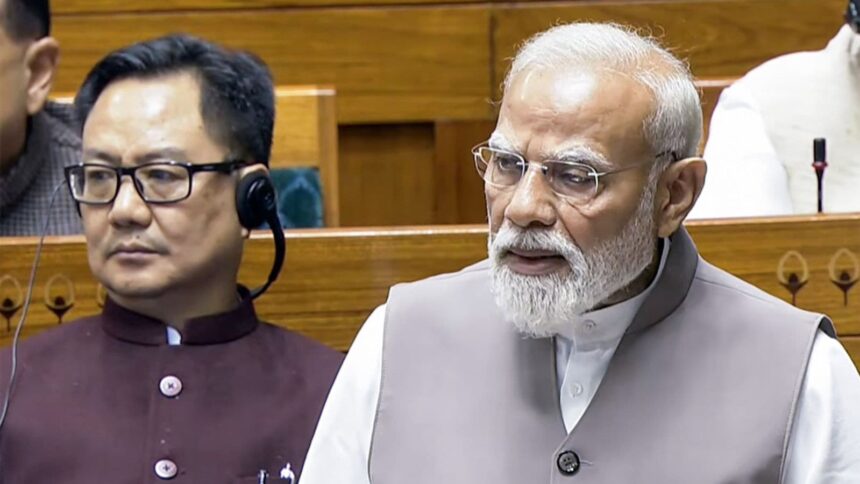
Leading with a strong diplomatic pitch, Prime Minister Monday informed Lok Sabha that India is “consistently working” to reduce tensions in West Asia, stressing that “dialogue and diplomacy are the only solutions” to the ongoing conflict, now in its third week.
Modi said he has spoken to leaders across West Asia in two rounds of calls, urging them to de-escalate and end hostilities. “India has opposed attacks on civilians and infrastructure linked to energy and transport. Attacks on commercial ships and blockage of the Strait of Hormuz are unacceptable,” he said, adding that New is actively engaging partners to ensure safe maritime corridors.
Positioning India’s stance as rooted in “humanity and peace”, PM Modi said the country is encouraging all sides to move towards a peaceful resolution at the earliest, warning that threats to civilian lives are “not in the interest of humanity”.
Even as he foregrounded diplomacy, Modi acknowledged that the West Asia conflict has triggered “unprecedented challenges” for India — spanning economic pressures, national security risks and humanitarian concerns — given the country’s deep trade ties with the region and its reliance on it for energy supplies.
“The region fulfils a large part of our energy needs and is a key trade route. Around one crore Indians live and work in the Gulf,” he said, underlining the scale of exposure. He noted that commercial shipping routes in the region also employ a significant number of Indians, heightening New Delhi’s concerns.
Detailing the government’s response, Modi said over three lakh Indians have returned home safely since the conflict began, including more than 1,000 from Iran, of whom over 700 were medical students. Indian missions in affected countries are operating round-the-clock control rooms and issuing regular advisories, while families of those killed or injured are being supported.
On the energy front, the Prime Minister said disruptions around the Strait of Hormuz have made shipping “very challenging”, but the government has taken steps to ensure minimal impact on domestic supplies. “We import nearly 60 per cent of our LPG needs, so domestic consumption has been prioritised and production is being increased,” he said.
He highlighted that India has diversified its energy imports from 27 countries earlier to 41 now, while building strategic petroleum reserves exceeding 53 lakh metric tonnes, with more capacity under development. Efforts are also underway to secure alternative supply routes and maintain uninterrupted fuel availability.
Modi said structural measures taken over the past decade—such as increased ethanol blending, expansion of renewable energy, electrification of railways and growth in refining capacity—have strengthened India’s resilience against global shocks.
Reassuring farmers and consumers, he said the country has adequate stocks of food grains, fertilisers and coal, and the government is monitoring supply chains closely through an inter-ministerial group that meets daily.
Calling for unity, the Prime Minister urged Parliament to send a “strong, collective message” to the world, while cautioning against misinformation and hoarding amid the crisis. Law enforcement agencies, he added, have been put on alert to prevent exploitation of the situation.
“The crisis may continue for a long time. We must remain prepared, patient and united,” Modi said, invoking India’s collective response during the pandemic as a template for navigating the current uncertainty.

