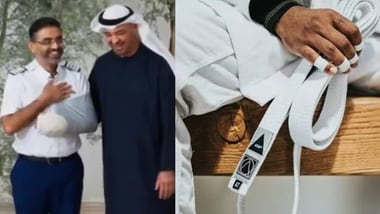
UAE President Sheikh Mohamed bin Zayed Al Nahyan made a light-hearted offer to teach jiu-jitsu to flydubai pilot Captain Smit Machchhar during an award ceremony in Abu Dhabi, honouring the Indian pilot for his courageous actions.
warmly embraced him and joked, “When you heal, I want to have a session with you to train you how to fight,” noting the UAE’s prominent status in jiu-jitsu. chuckled and replied that it would be his “biggest honour”.
Machchhar’s head injuries, including axe wounds and surgical stitches, were visible during the interaction for the first time, offering a glimpse into the severity of the attack. The assault had fractured his skull, with bone fragments pushed inward towards his brain tissue. He also sustained stab wounds, serious injuries to his hands and limbs, and wounds to his chest and upper abdomen.
Following the emergency landing in Tabuk, on September 30, the pilot was rushed for several hours of surgery, during which medical teams reconstructed his fractured skull. After the initial procedures, he was shifted to a specialised medical facility in Abu Dhabi for advanced neurological monitoring and post-trauma treatment.
Jiu-jitsu is a martial art and combat sport that focuses on grappling, controlling an opponent and using techniques such as joint locks and chokeholds to make them surrender, rather than relying primarily on punches and kicks.
Often described as the ‘gentle art’, it emphasises technique, leverage, balance and timing to help a person defend themselves, even against a physically stronger opponent.
The martial art has Japanese origins, while Brazilian Jiu-Jitsu (BJJ) developed as a distinct form in Brazil. It has gained international popularity through martial arts competitions, self-defence training and mixed martial arts (MMA).
The term jiu-jitsu, also spelt ju-jutsu or jujutsu, comes from Japanese words. ‘Ju’ refers to gentleness or yielding, while ‘jutsu’ means art or technique. The name reflects its underlying principle of using an opponent’s force, balance and movement to one’s advantage instead of relying entirely on physical strength.
According to the Ju-Jitsu International Federation (JJIF), different schools and styles of the martial art developed in Japan over several centuries. Its techniques traditionally included methods of unarmed combat, throws, joint manipulation and controlling an opponent.
Jiu-jitsu traces its roots to Japan, where it developed as a form of unarmed combat. Brazilian Jiu-Jitsu later emerged after Japanese martial arts expert Mitsuyo Maeda travelled to Brazil in the early 20th century.
According to the International Judo Federation’s historical account, Maeda was a Kodokan judoka who reached Brazil in 1914. His teachings influenced Carlos Gracie and other early Brazilian practitioners, who subsequently adapted and developed the techniques.
Over time, Brazilian Jiu-Jitsu evolved into a distinct martial art, placing greater emphasis on ground fighting, positional control and submission techniques. Its popularity expanded internationally, particularly through MMA competitions.
Unlike striking-based martial arts, Brazilian Jiu-Jitsu primarily involves grappling, taking an opponent to the ground and controlling their movements.
1. Takedowns: Bringing an opponent from a standing position to the ground while maintaining control.
2. Joint locks: Applying controlled pressure to joints, particularly the elbows, shoulders and knees, to force an opponent to surrender.
3. Chokeholds: Applying pressure to the neck to restrict blood flow or airflow, depending on the technique, prompting an opponent to submit.
4. Guard positions: Using the legs and body to control an opponent, particularly when fighting from the ground.
5. Escapes and sweeps: Techniques used to escape disadvantageous positions or reverse control and gain a better position.
According to the JJIF, the objective is generally to secure a submission through joint locks or chokeholds, or win through points awarded for actions such as takedowns and positional control.
Jiu-jitsu has several styles, but two commonly discussed forms are:
1. Japanese : The traditional Japanese martial art that includes unarmed combat techniques, throws, joint locks and methods of defending against attacks. Its historical applications included close-combat techniques.
2. Brazilian Jiu-Jitsu (BJJ): A Brazilian-developed form that focuses heavily on ground fighting, grappling, positional control and submission holds. It is widely practised as a competitive sport and self-defence discipline.
2. No-Gi Jiu-Jitsu: Participants wear athletic clothing, usually a rash guard and shorts. Gripping the opponent’s uniform is not permitted, making the contest more dependent on body grips and positional control.
The JJIF recognises both Gi and No-Gi formats in its competition framework.
A Brazilian Jiu-Jitsu match generally begins with both competitors standing. They attempt to take each other down before moving into ground-based combat.
A competitor can win by:
1. Submission: Making the opponent surrender through a joint lock or chokehold, commonly by tapping the opponent or the mat.
2. Points: Accumulating points through actions such as takedowns, guard passes and achieving dominant positions.
3. Referee decision: Winning when the match ends without a submission, based on the applicable scoring rules.
Unlike boxing or kickboxing, standard Brazilian Jiu-Jitsu competitions do not permit punches and kicks.
Brazilian Jiu-Jitsu uses a coloured belt system to indicate a practitioner’s experience, technical knowledge and progression.
For adult practitioners, the commonly recognised belt progression is:
– White belt
– Blue belt
– Purple belt
– Brown belt
– Black belt