



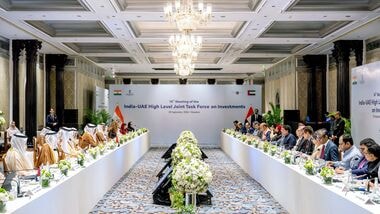
New Delhi: The UAE has indicated it may invest another $25 billion in India in the near future, while the countries have decided to double their annual trade to $200 billion by 2032, commerce and industry minister said on Monday.
The UAE has invested about $25 billion in India, and aims to raise investments to $100 billion in the years to come, Goyal said in Mumbai after co-chairing the 14th meeting of the India-UAE high-level joint task force on investments with Abu Dhabi Investment Authority (ADIA) managing director Sheikh Hamed bin Zayed Al Nahyan.
The meeting comes as the ongoing West Asia crisis has disrupted global supply chains, pushing up energy prices and threatening the overall trade and investment prospects in the region.
The UAE is India’s seventh-largest foreign direct investment source, and ADIA is one of the world’s largest sovereign wealth funds that invests on behalf of the Abu Dhabi government.
The UAE, the minister said, is looking at investments in Indian ports, shipbuilding, space, logistics, startups, and the stock market. Both sides have also zeroed in on half a dozen areas of shipping–from ship ownership to development of modern ports and ship manufacturing–for deepening cooperation. A bilateral working group will be set up to take the cooperation forward.
Set up in 2013 to promote economic ties between the two countries, the joint task force has provided an effective mechanism to discuss opportunities and prospects for further bilateral trade and investments, while acting as a forum to resolve issues faced by investors of the two countries, according to an Indian commerce ministry statement.
Goyal said the use of local currency for trade between India and the UAE has been rising, indicating double-digit growth.
“We can do that trade only in rupees and dirhams. When goods from India reach the UAE, we can bid in rupees. When goods from the UAE reach India, we can bid in dirhams,” he said.
Under the mechanism, Indian exporters receive payments in rupees, while imports from the UAE can be settled in dirhams, cutting the need to route bilateral transactions through the US dollar.
Surplus holdings of a trade partner’s currency could be converted into the US dollars after three to six months, the minister said. This mechanism is aimed at managing currency balances while promoting direct trade settlement in the two national currencies.
Both sides, the minister said, are considering bolstering cooperation in energy security, including strategic petroleum reserves, and LNG supplies, and subsea pipelines. “The studies are going on and we will be seeing significant ramp-up of investments from the UAE in this area,” he added.
On ports, Goyal said India’s capacity has doubled over the last decade, and would need to double again over the next decade as the economy grows at a fast pace.
“We will need to again double our port capacity in the next decade. And UAE will be an important investor, a trusted investor as we develop new ports or expand our existing ports,” he said.
Both sides have also agreed to have a more structured and formal working group on issues, including civil aviation cooperation, with a dialogue already underway on this issue, he said.
Monday’s meeting also dwelt on cooperation in space technology, food security, agri-innovation, logistics, artificial intelligence and emerging technologies, and .
While geopolitical conflicts impact trade, the India-UAE commerce is returning to the levels seen before the West Asia war, Goyal said.
Bilateral trade rose from almost $73 billion in the fiscal year through March 2022 to exceed $101 billion in FY26, buoyed by a free trade agreement that entered into force in May 2022.
“We are very close to it (pre-war levels), another few months and we should get back and beyond the pre-war levels. Obviously, this is a very critical issue that trade has been impacted because of this war,” Goyal said. “And we are finding ways and means to restore it both to the pre-war level and then grow it in the years to come.”