



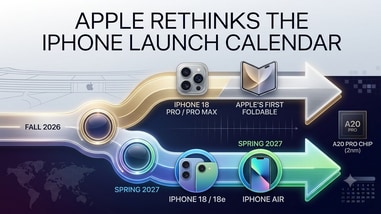
Apple Launch Event 9 September 2026, Surprise and Shine: Apple may be changing when it launches new iPhones. This year, the company is expected to unveil its top-end models in September, while the regular and other more affordable models could arrive several months later, in spring 2027.
Apple’s September 9 event is expected to focus on the iPhone 18 Pro and iPhone 18 Pro Max, alongside the company’s first foldable iPhone. The standard iPhone 18 is reportedly being pushed to spring 2027, potentially alongside the iPhone 18e and a second-generation iPhone Air.
That would create two distinct iPhone buying windows: a premium-focused launch in autumn and a broader, lower-priced refresh in spring.
The shift also comes as Apple’s iPhone portfolio expands. Instead of trying to introduce every model at one event, the reported strategy would give its high-end devices a clearer launch window while allowing other models to arrive later.
For years, Apple’s September event has been the moment when shoppers could choose between the latest standard iPhone and its more expensive Pro versions.
That is expected to change this year’s John ternus helmed Cupertino event.
Apple is set to focus its September 9 event on the iPhone 18 Pro and iPhone 18 Pro Max, alongside its first foldable iPhone, according to multiple reports. The standard iPhone 18 is not expected at the event.
Instead, the regular model could arrive in spring 2027.
Apple’s iPhone lineup is getting bigger. With the first foldable iPhone joining the Pro models and other versions, Apple could have as many as six iPhones in the 2026-27 cycle.
Reports suggest the company is therefore separating the launches, with the iPhone 18 Pro and Pro Max arriving today, September 9, followed by the iPhone 18, iPhone 18e and second-generation iPhone Air in spring 2027.
The staggered approach could also help Apple manage production more easily and give its high-end phones a clearer spotlight in the crucial September shopping season.
Analysts have also pointed to the possibility of spreading iPhone sales more evenly across the year.
The biggest change is simple: if you want a regular may no longer be the month to upgrade.
Someone looking to buy the latest Pro model would still have the traditional autumn window. But buyers interested in the standard iPhone could have to wait until spring 2027.
It could also change what happens to older iPhones. The iPhone 17 could remain Apple’s main standard model for longer after the September event, rather than immediately being replaced by a new-generation standard iPhone.
The split could also make Apple’s chipset roadmap more noticeable.
The , with a six-core CPU, six-core GPU with Neural Accelerators and a 16-core Neural Engine. Apple says its thermal design allows the chip to deliver up to 40% better sustained performance.
Before that, the A17 Pro introduced hardware-accelerated ray tracing and a six-core CPU, while the A18 Pro moved Apple further along its 3nm chip-generation cycle.
The upcoming A20 Pro, expected to power the iPhone 18 Pro, is reportedly moving to TSMC’s 2nm process. The smaller manufacturing process is expected to focus on performance and power efficiency, although Apple has yet to confirm detailed A20 Pro specifications.