


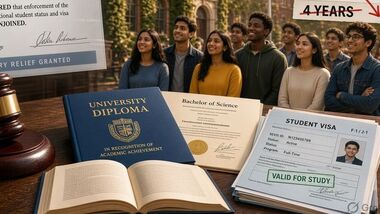
A US federal judge has temporarily blocked a Trump administration , including a four-year cap for most international students.
The by Massachusetts District Judge F. Dennis Saylor IV came just a day before the Department of Homeland Security (DHS) rule was scheduled to take effect. The judge said the policy was likely to cause “catastrophic” damage to the US higher-education system and economy and found that DHS had failed to comply with requirements under the Administrative Procedure Act.
The decision offers temporary relief to international students in the US, including a large Indian student population.
The .
Under the current system, foreign students can generally remain in the US for the duration of their academic programme as long as they maintain their authorised status.
The new system would have generally limited F-1 and J-1 admissions to the length of the programme, subject to a maximum of four years.
Students who needed additional time would have had to apply for an extension through US Citizenship and Immigration Services (USCIS), with approval left to government officials.
The rule also included a , and imposed additional restrictions on changing majors, transferring institutions and starting new programmes.
Judge Saylor said DHS was required to comply with the Administrative Procedure Act despite citing national security and border-control concerns.
The judge found that the plaintiffs were likely to succeed in challenging the rule and that implementing it could cause immediate and irreparable harm.
“The damage to the higher education system and to the economy of the United States is likely to be catastrophic,” Saylor wrote.
He also rejected the government’s argument that any injunction should apply only to the organisations that brought the case.
The plaintiffs represent nearly 600 public and private institutions, while more than 5,000 higher-education institutions operate across the US. Saylor said limiting relief would create parallel regulatory systems and potentially inconsistent decisions.
For Indian students, the immediate impact is relief from the four-year cap and associated fixed-term admission requirements while the legal challenge continues.
Students who are already in the US can continue to operate under the existing framework for now, rather than being immediately pushed into the new extension system.
This is particularly significant for Indian students pursuing longer academic programmes, including doctoral and research courses. Harvard President Alan Garber had previously questioned the four-year limit, noting that a typical PhD can take at least six years.
The ruling also means students are not immediately subject to the proposed additional restrictions on changing programmes, transferring institutions or pursuing another degree.
India is currently the largest source of international students in the United States.
According to the Open Doors 2025 report cited in the case material, 363,019 Indian students were enrolled at US colleges and universities during the 2024-25 academic year, accounting for nearly 31% of all international students in the country.
That makes any change to the US student-visa system particularly important for Indian students, universities and families considering higher education in America.
The rule could have created additional uncertainty for students whose courses extend beyond four years, particularly those in doctoral, research and other lengthy programmes.
Under the blocked rule, students requiring additional time would have needed to file a formal Extension of Stay application with USCIS.
The decision temporarily prevents that new system from taking effect.
However, the judge’s ruling is a preliminary injunction, not a final decision on whether DHS can ultimately introduce a fixed-term visa system.
The underlying legal challenge will continue, so the rules governing international students could change again depending on the final outcome.
The proposed rule also contained provisions .
Those travelling outside the country after the rule took effect could have been subject to the new fixed-date admission system.
Because implementation has now been postponed, those provisions do not take effect while the injunction remains in place.
The DHS rule was not limited to students.
Foreign journalists holding I visas would have faced a 240-day admission limit, while Chinese media representatives would have been subject to a 90-day limit.
Judge Saylor raised concerns about the possibility that the rule could be used against journalists critical of the government, particularly DHS officials.
He questioned whether the policy’s actual purpose could extend beyond national security and border protection to greater government control over academic institutions and the press.
DHS had argued that the fixed-term system would help combat fraud and make it easier for the government to identify and address visa overstays.
The department also said the existing duration-of-status system had allowed some foreign students, exchange visitors and media representatives to remain in the US without sufficient routine government oversight.
The judge, however, found that national-security and border-control claims did not exempt DHS from its obligations under the Administrative Procedure Act.
For prospective Indian students, the ruling removes an immediate source of uncertainty, but it does not permanently eliminate the proposed four-year limit.
The legal battle is still underway, meaning students and universities will have to monitor further court decisions and any subsequent action by DHS.