



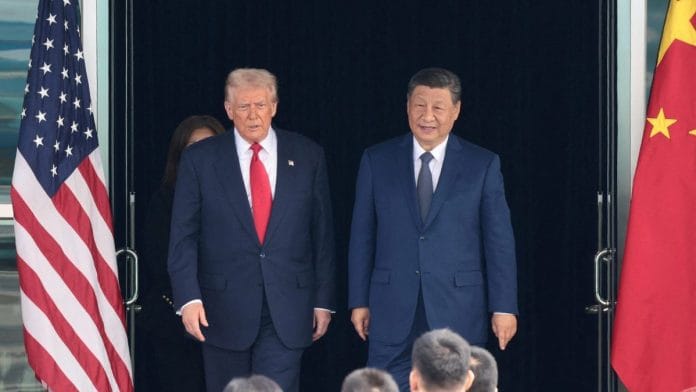
In this environment, as Washington and Beijing size each other up and search for leverage across multiple domains, the Trump-Xi summit is less about grand posturing and more about strategic recalibration. Both sides recognise the lure and liabilities of deep economic interdependence, even as geopolitical realities push them toward structural rivalry. Equally, both understand that the consequences of their cooperation or confrontation will reverberate far beyond the bilateral relationship and shape the trajectory of the international system itself.
The US and China are neither locked in a Cold War-style détente nor bound by the kind of deterrence architecture that once underpinned US-Soviet relations through formal arms control agreements. Despite Trump’s occasional references to a possible “,” no stable great-power duopoly has crystallised. What exists instead is a form of transactional stability: a deeply competitive relationship that is managed, but sustained only by a thin and fragile layer of restraint.
As US-Russia arms control agreements drift into, calls for China’s inclusion in future strategic arrangements are increasingly being framed as imperative, given Beijing’s rapidly expanding conventional and nuclear capabilities vis-à-vis the US. Both Washington and Beijing seek their rivalry from spiralling into inadvertent confrontation, even as they continue to compete aggressively for leverage across trade, technology, military posture, and global governance.
Discussions during the summit are expected to tariffs, export controls, semiconductors, rare earths, AI governance, maritime chokepoints, Iran, and Taiwan. The contours of the emerging great-power relationship will increasingly be shaped by these arenas of competition, confrontation, and selective cooperation. Amid multiple global distractions, the summit offers Washington an opportunity to demonstrate that its China-focused grand strategy remains firmly intact, while for Beijing, it is another moment to project growing parity within an increasingly consequential peer rivalry. Although the geopolitical theatre of the US-China equation now stretches from the conflict zones of West Asia to America’s strategic neighbourhood, the Indo-Pacific the principal arena of this intensifying contest.
With the Trump administration distracted across multiple theatres, questions persist over Washington’s bandwidth and presidential focus, even as the US appears intent on “” in the region on the ground. This is evident in developments such as the Major Defence Cooperation Partnership (MDCP) between the US and Indonesia, as well as Japan the latest edition of the multinational Balikatan military exercises hosted by the US and the Philippines. The summit also comes on the heels of the latest ASEAN summit hosted in the Philippines, and for a Foreign Ministers’ meeting of the Quadrilateral Security Dialogue in New Delhi later this month.
The summit also comes at a critical juncture in the intersection of geopolitics and geoeconomics, one that the Strait of Hormuz crisis has unmistakably exposed. China’s massive energy through the chokepoint make regional instability a direct threat to Beijing’s economic security. The US, meanwhile, has already begun to feel the the crisis both internationally and domestically through inflationary shocks, energy volatility, supply-chain disruptions, and reputational damage, amid the Trump administration’s midterm election campaigns. Consequently, tactical crisis management looms large even as the US and China remain locked in structural competition, while recognising their mutual vulnerabilities.
The Trump-Xi summit also exposes at the heart of contemporary great power politics: two competing powers that are too economically intertwined to fully decouple, too strategically hostile to cooperate deeply, and too consequential to risk reckless military confrontation. In that sense, parts of the relationship echo Cold War-style deterrence, yet many dimensions are entirely new and without precedent in earlier great-power rivalries. There has also been a renewed discourse surrounding the “G2” framework.
What Trump’s rhetoric signals, however, is not necessarily the emergence of a formal G2 arrangement, but rather a shift in the logic of great power recognition itself. A great power, after all, derives status not merely from capabilities, but also from recognition by other great powers. Trump’s framing acknowledges China as America’s principal peer competitor. For countries like India, such rhetoric naturally raises concerns about the possibility of Washington and Beijing informally shaping the terms of global order over the heads of other major powers, effectively undermining the dynamics of a multipolar world order.
For much of the past two decades, the India-US strategic partnership has been built on the a broad convergence between Washington and New Delhi over concerns regarding China’s rise and assertiveness. The Indo-Pacific framework, the Quad, defence interoperability, technology cooperation, and supply-chain partnerships all emerged within this larger geopolitical logic. However, it remains a fact of strategy that US-China dynamics are far broader than the framework of the India-US partnership and possess a trajectory beyond New Delhi’s control or influence. In this context, developments within the US-China bilateral relationship remain a central priority in India’s strategic calculus.
This does not, of course, fundamentally weaken the India-US partnership, but it does call for nimble-footedness in New Delhi to navigate the new age of transactionalism in the US-China relationship. Broader geopolitical alignment with the US will not automatically insulate India from the vagaries of transactional pressures, and everything on the menu of the Trump–Xi summit will have either a primary or secondary-order impact on the near future of the India-US relationship and the direction of India’s foreign policy.
In recent times, a Trump administration that has been aggressive on the economic front and uncertain on the strategic front to greater accommodation in India-China strategic positioning.
Therefore, the fallout of the Trump-Xi summit will be germane to the fragile yet consequential triangular dynamics between the US, India, and China. For India, the challenge is particularly critical for both its military modernisation and economic growth: how to navigate a geostrategic environment in which both Washington and Beijing seek to pull New Delhi into their respective strategic calculations, even as the US and China retain space for tactical bargaining that may not necessarily take India’s concerns into account.
The Trump-Xi summit, consequently, is unlikely to produce dramatic breakthroughs, but it does appear to reinforce a new playbook in great power relations—a new grammar in which geopolitics is inseparable from geo-economics. The result is rivalry without full decoupling, competition without Cold War-style blocs, and continued engagement without enduring commitments.
Monish Tourangbam is a Fellow at the Chintan Research Foundation (CRF), New Delhi. Views are personal.
(Edited by Saptak Datta)

