



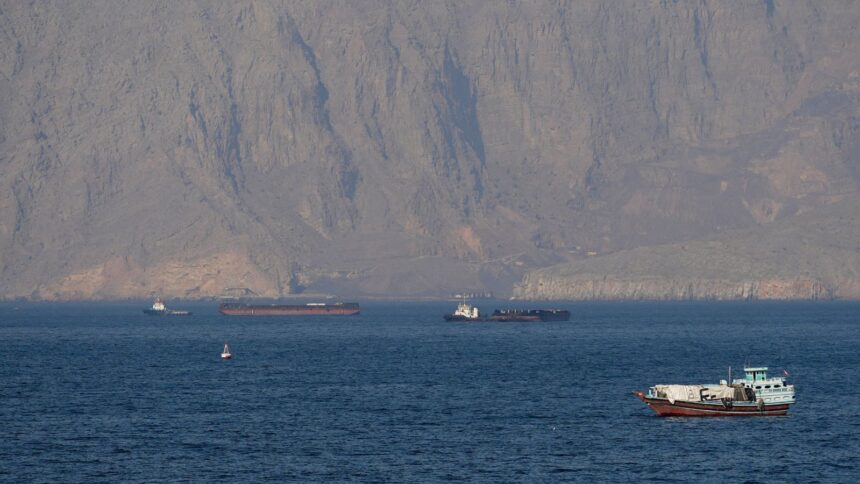
Tensions in the escalated sharply on Saturday after Iran reimposed restrictions on the critical waterway and fired on a commercial tanker, raising fears of a fresh energy shock and renewed conflict with the United States, even as diplomatic efforts continue ahead of a looming ceasefire deadline. US President Donald Trump also hardened Washington’s stance, asserting that Iran would not be allowed to pressure the United States through disruptions in the vital oil route.
“We have very good conversations going on,” Trump said at a White House event. Referring to Tehran’s latest moves, he added, Iran “got a little cute. They wanted to close up the strait again; they can’t blackmail us.”
Trump also reiterated that the targeting Iran would continue the blockade “will remain in full force” until Tehran agrees to a deal with Washington, including on its nuclear programme.
Dismissing Iran’s proposal to impose tolls on vessels transiting the Strait of Hormuz, he said, “Nope. No way. No. Nope… No, they’re not going to be tolls.”
Iran abruptly reversed its decision to reopen the Strait of Hormuz, announcing that “control of the Strait of Hormuz has returned to its previous state … under strict management and control of the armed forces”.
According to the United Kingdom Maritime Trade Operations (UKMTO), two gunboats from Iran’s Revolutionary Guard opened fire on a tanker transiting the Strait of Hormuz. The tanker and its crew were reported safe, though the vessel was not identified.
The Strait of Hormuz handles around 20% of global oil shipments, making it one of the most sensitive chokepoints in global trade.
A report by The Wall Street Journal reveals that the US is preparing a significant escalation at sea. According to US officials cited by the publication, the military is planning to board and seize Iran-linked oil tankers and commercial ships in international waters and
operations could extend beyond the Middle East, targeting vessels globally. It added that the move is part of a broader strategy dubbed “Economic Fury”.
General Dan Caine, chairman of the Joint Chiefs of Staff, said, “The US will actively pursue any Iranian-flagged vessel or any vessel attempting to provide material support to Iran.”
He added the campaign would include “dark fleet vessels carrying Iranian oil,” referring to ships evading sanctions and regulations.
The report further said the US has already turned back 23 ships near Iranian waters, while Washington is expanding sanctions targeting Iran’s oil trade networks.
6 questions · How closely have you been following the escalation?
What share of global oil shipments passes through the Strait of Hormuz?
How many ships has the US military turned back since the Hormuz blockade began?
What conditions did Iran announce for vessels wishing to transit the Strait of Hormuz?
Which country is currently mediating talks between the US and Iran ahead of the ceasefire deadline?
How many barrels of oil was the Indian-flagged supertanker carrying when it was forced to reverse course?
By when is the US-Iran ceasefire set to expire, according to current reports?
Your score on the Strait of Hormuz quiz
The Strait of Hormuz — through which about 20% of global oil flows — is at the centre of a rapidly escalating standoff. Iran reimposed restrictions, fired on a tanker, and signalled tolls and permits for passage. The US has turned back 23 ships and is planning to board Iran-linked vessels globally. A ceasefire deadline looms on April 22, with Pakistan mediating.
Saturday’s escalation underlines rapidly shifting and often contradictory signals:
Iran’s Supreme National Security Council said it would maintain control over Hormuz until, “the war fully ends and lasting peace is achieved in the region”.
It also warned that the strait would not fully reopen unless the US lifts its naval blockade.
India has already been drawn into the fallout as two Indian-flagged vessels were forced to reverse course after gunfire following which New summoned Iran’s ambassador, expressing “deep concern”.
Despite the escalation, diplomatic efforts are ongoing. P between the US and Iran even as a ceasefire is set to expire on April 22.

