


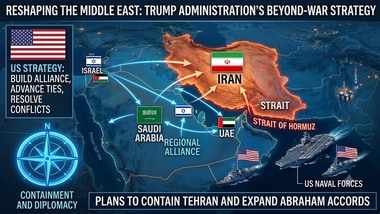
The Trump administration is weighing a broad strategy to reshape the Middle East after the Iran war, with plans under discussion to build a regional alliance to contain Tehran, advance Israel’s ties with Arab states and resolve several conflicts left in the wake of the October 7, 2023 attacks, according to US officials and people familiar with the discussions, Axios reported.
, but it could become a central part of US policy in the region during the final two years of President Donald Trump’s term.
The emerging strategy is being worked on at both senior political and inter-agency levels, according to Axios citing the people familiar with the matter . Trump has discussed the idea with senior advisers at two meetings in recent weeks, where different proposals for the region were considered.
In private conversations, Trump has described his ambitions as “something much bigger” in the .
The strategy could also be shaped by two major elections: Israel’s October 27 vote and the US midterm elections in November. Administration officials are hoping that Israel’s next government will be prepared to work with Washington on the broader regional agenda.
Some US officials, however, have indicated that Trump intends to pursue the strategy regardless of the outcome of the Israeli election, including if the vote results in a political deadlock.
One of the main ideas under consideration is the creation of a stronger regional alignment among US allies to counter Iran.
Under the proposal, Washington would serve as a guarantor of the arrangement, giving the regional grouping a security framework aimed at limiting Tehran’s influence.
The approach would mark a shift from dealing with Iran primarily through individual bilateral relationships towards a broader regional structure involving multiple US partners.
The details remain unsettled, including whether all of Washington’s regional allies would agree to participate.
Axios report said the strategy could take several more weeks to complete. “They are cooking it, but it is not yet cooked,” the report quoted an official.
The proposed strategy is not limited to Iran.
Another element under discussion is an effort to bring the regional consequences of the October 7 attacks closer to a conclusion. That could involve advancing the next phase of Trump’s Gaza plan, securing a security agreement between Israel and Syria and implementing the existing Israel-Lebanon agreement.
The objective would be to link several unresolved regional issues rather than address them separately.
That approach could give Washington a wider framework for negotiations involving Israel and its neighbours while also attempting to reduce the risk of further conflict spreading across the region.
A third component of the emerging strategy is an expansion of the Abraham Accords, the agreements that established or normalised relations between Israel and several Arab countries.
A Saudi-Israeli normalisation agreement would be a major part of that effort.
Saudi Arabia and Israel have not established formal diplomatic relations, although Washington has previously pushed for an agreement between the two countries. Bringing Riyadh into a broader regional framework would also give the strategy a significant diplomatic and economic dimension.
The administration is therefore considering a package that would combine pressure on Iran with expanded diplomatic ties between Israel and its neighbours.
The timing of is an important factor in Washington’s planning.
The Trump administration wants any new Israeli government to be willing and able to cooperate with its post-war strategy. But officials have also stressed that the US president does not intend to wait indefinitely for Israel’s political process to settle.
The November US midterm elections are another consideration as the administration looks at how its Middle East policy will fit into the final two years of Trump’s term.
For now, the strategy remains a work in progress. The central idea, according to a person briefed on the process, is to connect several of the region’s major diplomatic and security issues into one broader framework.
“The idea is to tie a whole lot of things in the region together — how you create a regional alignment after the war. It is still unclear if all U.S. allies in the region will be on board,” the Axios report added.