



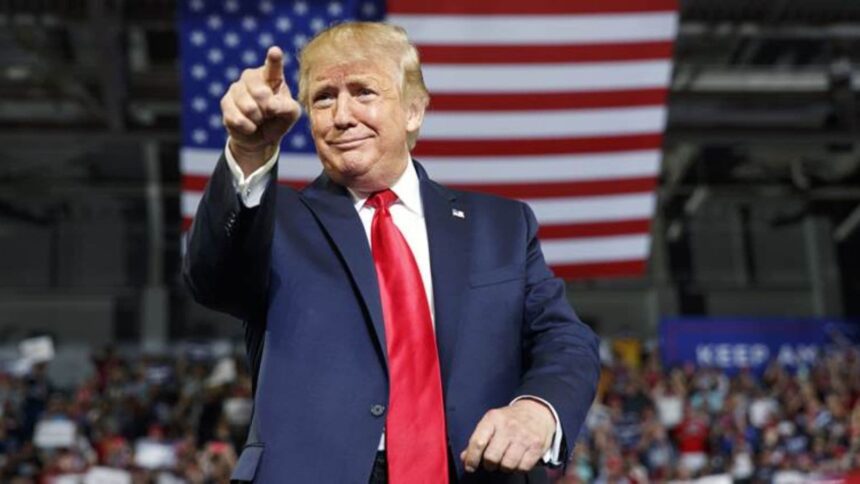
US President Donald Trump on Friday announced that tariffs on cars and trucks imported from the European Union will be increased to 25 per cent, with the revised rates scheduled to come into effect next week. The decision alters the existing tariff structure agreed between the two sides and directly affects transatlantic automotive trade.
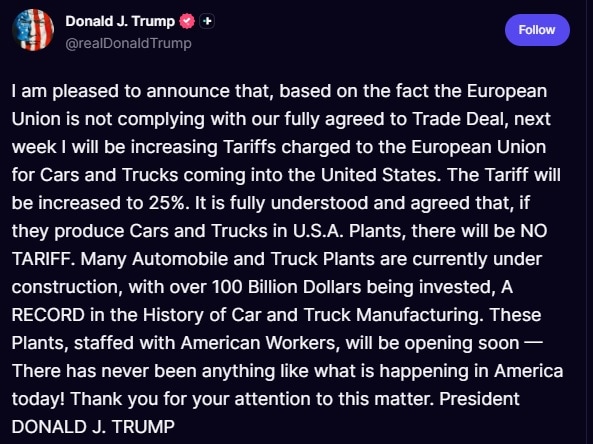
Trump said the move was prompted by what he described as the EU’s failure to comply with a previously finalised trade agreement, stating that the bloc “is not complying with our ,” without detailing specific violations.
He added, “It is fully understood and agreed that, if they produce Cars and Trucks in U.S.A. Plants, there will be NO TARIFF. Many Automobile and Truck Plants are currently under construction, with over 100 Billion Dollars being invested, A RECORD in the History of Car and Truck Manufacturing. These Plants, staffed with American Workers, will be opening soon — There has never been anything like what is happening in America today! Thank you for your attention to this matter.”
The current framework traces back to a deal reached in July between Trump and Ursula von der Leyen, which had set a 15 per cent tariff ceiling on most goods. The arrangement, referred to as , was earlier reaffirmed by both sides as the basis for ongoing trade relations.
However, the agreement’s status came under question following a ruling this year by the Supreme Court of the United States, which held that the president lacked the legal authority to invoke an economic emergency to impose tariffs on EU imports.
As a result, the initial 15 per cent tariff ceiling was reduced to 10 per cent while the administration introduced alternative import duties under different legal provisions.
The Trump administration is currently conducting investigations into trade imbalances and potential national security risks as part of efforts to establish a revised tariff regime, a process that could place the existing agreement with the EU at risk of being breached.
Prior to these developments, the EU had estimated that the bilateral arrangement would result in savings of approximately 500 million to 600 million euros per month for European automakers. Data from Eurostat shows that total trade in goods and services between the EU and the United States reached 1.7 trillion euros in 2024, equivalent to roughly 4.6 billion euros per day, Associated Press (AP) reported.
In February, the European Commission reiterated its position following the court ruling, stating, “A deal is a deal,” and emphasising that, as the United States’ largest trading partner, the EU expects Washington to honour the commitments outlined in the joint statement, while maintaining that EU goods should continue to benefit from the agreed tariff limits without increases.

