



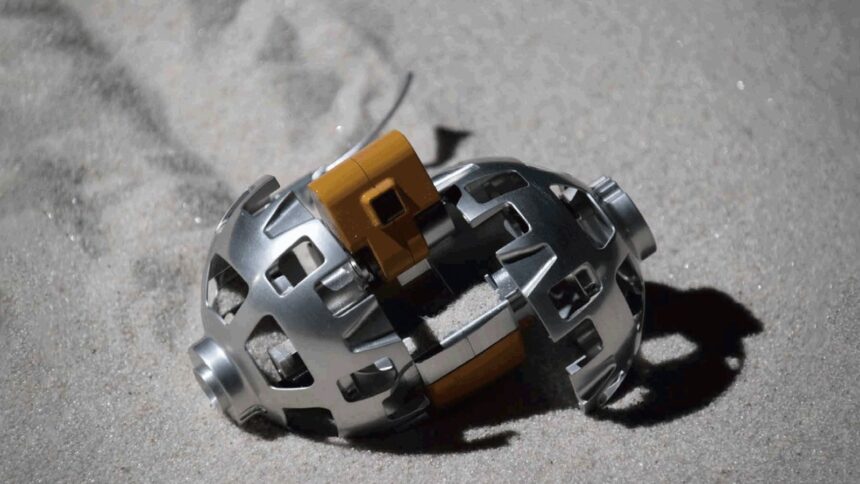
A tiny shape-shifting robot no bigger than a palm has become one of the most unlikely heroes of lunar exploration. The miniature rover, known as the Palm-Sized Lunar Excursion Vehicle 2 (LEV-2), helped scientists solve what went wrong with Japan’s SLIM moon lander on the lunar surface in January 2024.
New research published in the journal Science Robotics explains how the rover successfully explored the moon, captured historic images, and demonstrated technologies that could play an important role in future lunar and Mars missions.
Developed by the Japan Aerospace Exploration Agency, LEV-2 was deployed from the SLIM spacecraft shortly after landing. Japan became the fifth nation to achieve a soft landing on the moon, but celebrations were quickly overshadowed when engineers discovered that the SLIM lander was unable to generate sufficient power because it had landed in the wrong orientation.
That is where LEV-2 stepped in.
The rover, which resembles the BB-8 droid from Star Wars, can transform from a spherical shape into a small wheeled vehicle. Using its unique design, it rolled across the lunar surface and photographed the surrounding terrain. One of those images revealed the cause of SLIM’s problems: the spacecraft was lying upside down.
The photograph became one of the most important images of the mission, allowing engineers on Earth to assess the lander’s condition and understand why its solar panels were not functioning as expected.
Despite operating for only around 100 minutes, LEV-2 exceeded expectations. The rover relayed information through a companion hopping robot known as LEV-1 before eventually losing contact.
Researchers say the mission demonstrated the potential of small autonomous robots to support larger spacecraft during planetary exploration. While large-scale rovers have their limitations, smaller robots like LEV-2 have the potential to conduct research in harsh environments, collect information independently, and act as additional sources of information should anything go wrong with the principal vehicle.
The project demonstrated a variety of important technical advances, which include a shape-adaptive locomotion system, autonomous navigation, wireless communication, and image processing. These qualities might become invaluable for exploring hard-to-explore regions of the Moon, Mars, and other planetary bodies.
Despite having a short lifespan, the robot managed to reach its primary goal and deliver important information about one of the most peculiar landings in the history of lunar exploration.
According to scientists, the project’s success is indicative of how, in the future, a variety of inexpensive robots may operate in tandem with larger spacecraft.

