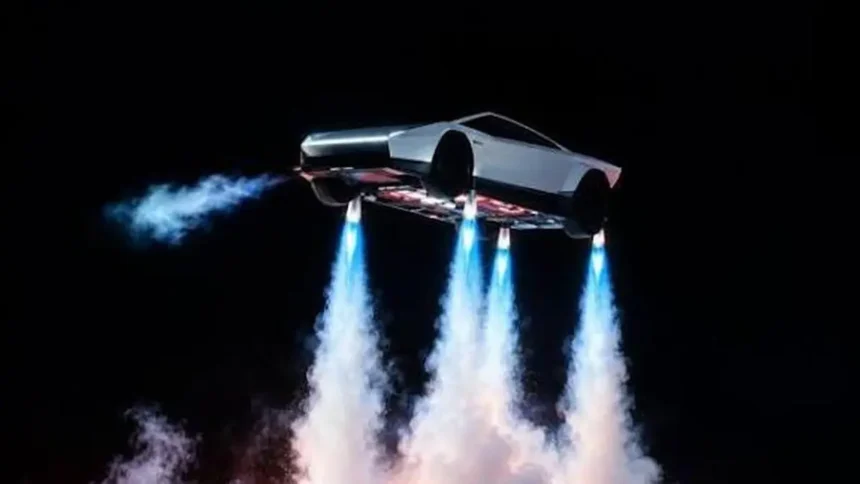
Tesla has opened Indian reservations for two configurations of its new Roadster electric sports car, while a third, potentially flight-capable version could reach selected buyers by invitation. The announcement comes as the American automaker’s registrations surged 836 per cent during April–September, placing it third in India’s luxury electric-vehicle market behind BMW and Mercedes-Benz.
Unlike its existing Model Y SUVs, the Roadster is a low-slung, two-seat sports car with removable roof panels, developed for extreme acceleration. Tesla says its design draws inspiration from the SR-71 and F-35 aircraft and incorporates SpaceX components.
Indian customers can reserve Performance and Thrust configurations. Performance emphasises electric propulsion and aerodynamic grip, with a claimed zero-to-60 mph time below 1.6 seconds. Thrust adds rocket-inspired propulsion assistance, with a claimed time below 0.9 seconds. Production specifications remain subject to confirmation.
Both require an initial ₹5.01-lakh payment, according to reported Indian reservation details. Performance requires another ₹45.05 lakh within 10 days, taking the deposit to ₹50.06 lakh. Thrust requires another ₹2,45,24,000, bringing its deposit to ₹2,50,25,000. Final selling prices remain unannounced.
The third configuration, Rocket, could also make its debut in India, offering selected buyers the possibility of owning Tesla’s proposed flying sports car. Equipped with rocket-derived propulsion technology intended to enable flight, it would be available exclusively by invitation.
“It is definitely possible. It is just that it is by invitation,” an industry source familiar with developments told BusinessLine, referring to the prospect of Indian buyers accessing Rocket.
The source explained that automotive engineering has long borrowed technologies from aerospace, but rocket-derived propulsion could take that convergence further.
“It is a different dimension, where rocket technology comes inside the car, and it can fly,” the source said, describing the shift from conventional automotive propulsion towards technologies associated with space exploration.
The proposed flying capability remains subject to technical validation and regulatory approvals. Roadster production is targeted for 2028, initially with left-hand-drive vehicles. Indian deliveries have not been scheduled.
Tesla registered 646 vehicles during April–September 2026, against 69 a year earlier, according to Vahan data compiled as of October 11. Its luxury EV market share rose to 14.6 per cent from 2.5 per cent. September registrations reached 296, overtaking Mercedes-Benz’s 128.
However, direct comparisons with established luxury manufacturers overlook differences in distribution reach and market maturity. Tesla has seven centres in India, while several established rivals operate networks exceeding 50 outlets, supported by longstanding customer relationships and repeat purchases.
Tesla’s direct-to-consumer model also requires greater customer awareness as the company expands beyond its initial markets.
Tesla currently sells the five-seat Model Y from ₹50.89 lakh and six-seat Model Y L from ₹61.99 lakh. The latter targets Indian families seeking greater passenger and luggage space. Complimentary Acceleration Boost enables the Model Y L to reach 100 km/h in a claimed 4.5 seconds, with up to 681 km of WLTP range.
Tesla operates 20 Supercharger stalls across five stations and 28 Destination Charger stalls across seven stations. Three additional charging sites are planned by December.
The company intends to expand charging infrastructure across major cities and connecting highways, although it has not disclosed a numerical expansion target. Restrictions imposed by residential societies on home-charger installations remain another obstacle to wider adoption.
For Tesla, expanding its physical reach and overcoming charging barriers will determine whether early enthusiasm translates into sustained luxury EV sales..
Published on October 17, 2026