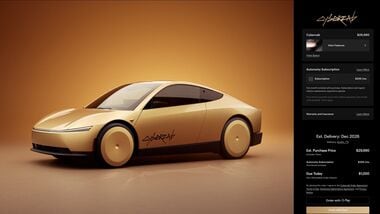
Tesla has started inviting select customers to buy its driverless Cybercab for personal use, bringing Elon Musk’s vision of a car without a steering wheel or pedals closer to reality. The two-seater electric vehicle is being offered at an estimated $29,990, but owners will also have to pay a monthly subscription to use its autonomous driving features.
The announcement, shared by Tesla on X on Friday, marks a new step in the company’s efforts to move beyond operating robotaxis and put fully driverless vehicles in private owners’ hands.
An image accompanying the post showed an estimated delivery date of December, although the company has not provided a wider delivery schedule.
has listed an estimated purchase price of $29,990, excluding taxes. Customers will also need to pay a $299 monthly fee for an ‘Autonomy Subscription’ and put down a non-refundable deposit of $1,000.
However, the subscription price may change. Tesla chief executive Elon Musk said the monthly charge was too high and should eventually be closer to the cost of Full Self-Driving and connectivity services offered with other Tesla models, which together cost around $115 a month.
Elon Musk also said the Cybercab would be available nationwide as the company receives regulatory approvals.
The vehicle has two seats and does away with conventional driving controls, including a steering wheel and accelerator and brake pedals. Its distinctive design includes golden butterfly-style doors.
The Cybercab will initially be available to customers in locations where Tesla already operates its unsupervised robotaxi service.
Ashok Elluswamy, , said the privately owned vehicles would be able to operate without supervision in the same geographical areas as the company’s robotaxi fleet.
Tesla launched its unsupervised robotaxi service in Austin, Texas, in June 2025. It subsequently expanded to Dallas and Houston in April 2026 and Miami in July 2026.
The company had previously invited fleet operators to register their interest in the Cybercab, but Friday’s announcement marks a move towards individual ownership.
Despite the announcement, regulatory approval remains a major hurdle for Tesla’s driverless ambitions.
In September, the US National Highway Traffic Safety Administration opened an investigation into the Cybercab, examining the technical information and process Tesla used to certify that the vehicle meets federal safety requirements.
The absence of a steering wheel, pedals and conventional mirrors has raised questions about how the vehicle complies with existing road safety rules.
State laws also continue to require human supervisors or drivers to be available in many areas where autonomous vehicles operate.
Tesla has promoted the as a vehicle that could make transport easier and more accessible, including for people with disabilities. However, its wider availability will depend on regulatory decisions.
Tesla is not alone in trying to bring driverless transport to American roads.
Waymo, the autonomous driving subsidiary of Google’s parent company Alphabet, already operates commercial robotaxi services in 11 US cities.
Tesla, meanwhile, is attempting to take the concept a step further by allowing customers to own vehicles designed to operate without a human driver.
Whether the Cybercab becomes widely available will depend not just on customer demand and production, but also on whether regulators allow a car without conventional driving controls to operate on public roads.