



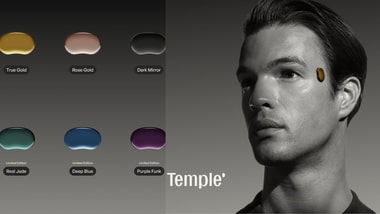
Zomato founder Deepinder Goyal’s new Temple wearable is drawing attention for a simple reason: it does not sit on your wrist. The device is small and pill-shaped and is attached to the side of the head to monitor aspects of the brain’s blood flow. Goyal has said that the applications of Temple could extend beyond fitness tracking, including checking whether pilots are fit to fly.
Goyal posted the comments on X on Thursday, October 8, following his announcement that pre-orders in India would open soon. He said that he “certainly would have it on pilots” and noted that perhaps the Indian Air Force can use it to determine who is the fittest for a given mission. However, Temple is not approved, established and certified as a pilot-fitness or aviation safety device at this time.
Temple is designed to fit between the forehead and the ear. It is not like wearing a watch strap; it is secured by disposable adhesive ‘Grips’.
According to Goyal and Temple, the device can remain on during activities such as running, swimming and showering. The company states the grips will last up to seven days, but recommends changing them every two to three days, especially when sweating or exposed to dust.
The launch version is expected in six colours: True Gold, Rose Gold, Black Mirror, Real Jade, Deep Blue and Purple Funk.
Temple employs photoplethysmography (PPG), a that’s also used in smartwatches. But instead of measuring signals from the wrist, Temple places the sensor near the temple.
The company calls this system BrainFlow. It is used to monitor the changes in cerebral blood flow. Goyal said the data could eventually be used to provide insights into sleep, recovery, exercise and stress response.
BrainFlow does not measure brain activity directly like an EEG, however, and Temple is not able to diagnose medical conditions at this time.
Goyal has published two validation studies. The first had 23 healthy adults who were compared against BrainFlow readings while pedalling and changing posture with Transcranial Doppler measurements.
A second study looked at 44 healthy men who participated in 60 sessions. According to results shared by , BrainFlow showed correlations of up to 0.91 with changes in brain blood volume measured using time-domain near-infrared spectroscopy.
Both studies are preprints and have yet to be peer-reviewed. Thus, the results have to be validated independently.
Goyal’s comments are indicative of a potential capability, not an existing one. It is theoretically possible that continuous physiological data could be used to assess a person’s condition prior to a high-stakes task.
For the time being, there is no evidence that Temple can make a determination on whether a commercial pilot is medically fit to fly. There are still existing medical and regulatory procedures that govern aviation fitness decisions.
Earlier, Goyal had said that the cost of a Temple in India is around ₹1 lakh. The final India price is not yet available.
Pre-orders should be available soon, and waitlist users will receive priority. The company is also testing ideas for thought-to-text technology, though he anticipates that it will be several years in the future.
For now, the fact that Temple is positioned so uniquely, has BrainFlow technology and has such ambitious future applications, separates it from standard smartwatches and fitness trackers.