



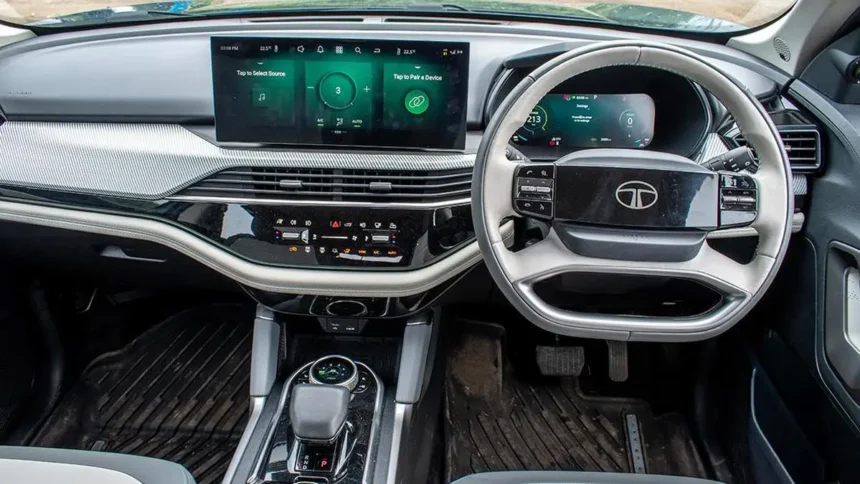
Tata Motors widened its lead in India’s electric passenger vehicle market in July, opening a gap of nearly 6,000 registrations over Mahindra and increasing its share of monthly EV registrations to about 43 per cent, according to the latest VAHAN registration data reviewed by businessline.
Tata registered 13,579 electric passenger vehicles during the month, up 101.8 per cent from a year earlier, while Mahindra more than doubled registrations to 7,677 units, a 124.7 per cent increase, although it remained a distant second. Senior Tata Motors officials said the company’s share of monthly EV registrations has climbed steadily from about 38 per cent in March to 43 per cent in July.
India’s passenger vehicle market remained on a strong growth trajectory, with registrations rising 18.4 per cent year-on-year to 4,05,658 units from 3,42,532 in July last year. Electric vehicles accounted for 31,788 registrations, while conventional fuel-powered passenger vehicles contributed the remaining 3,73,870 units, taking EV penetration to 7.8 per cent.
While Tata retained a comfortable lead in absolute EV registrations, Mahindra emerged as the fastest-growing among the leading electric vehicle manufacturers, with registrations jumping 124.7 per cent year-on-year.
MG Motor India retained the third position with 5,642 registrations despite a 4.4 per cent decline from a year earlier.
Maruti Suzuki continued to ramp up registrations of the e VITARA, reaching 1,590 units in July, while VinFast established an early presence in the market with 1,478 registrations.
Competition also continued to broaden. Kia gained momentum on the back of the Carens Clavis EV and is expected to receive a further boost from the recently introduced Syros EV. Toyota also expanded its electric vehicle presence gradually, reflecting the widening choice of EVs across price points.
Hemal Thakkar, Senior Director and Senior Practice Leader at Crisil Intelligence, said passenger vehicle demand remained resilient despite the seasonal moderation associated with the monsoon, with SUVs continuing to drive industry growth.
Thakkar said improving charging infrastructure, favourable ownership economics and a wider choice of products are accelerating electric vehicle adoption.
Even so, internal combustion engine vehicles continue to account for more than nine out of every 10 passenger vehicle registrations, indicating that while electrification is gathering pace, conventional powertrains will remain the industry’s volume driver for the foreseeable future.
Maruti Suzuki retained its leadership in the overall passenger vehicle market with 1,61,368 retail registrations in July, up 19.4 per cent from a year earlier.
Maruti’s record production profile also reflects where demand is headed. The country’s largest carmaker increased passenger vehicle production 33.4 per cent year-on-year to 2,44,445 units in July, led by a 46.3 per cent jump in utility vehicle output to 1,02,787 units.
The increase was driven by its SUV and MPV portfolio, including the Brezza, Fronx, Ertiga, XL6, Jimny and e VITARA, while production of passenger cars such as the Swift, Dzire, Baleno and WagonR rose 27.8 per cent to 1,27,031 units. The production mix reflects the industry’s continued shift towards SUVs ahead of the festive season.Among the leading manufacturers,
Tata Motors posted the strongest growth, with registrations rising 36.5 per cent to 58,399 units, followed by Mahindra, whose registrations increased 22.0 per cent to 55,587. Hyundai Motor India grew 5.4 per cent to 47,688 units, Toyota Kirloskar Motor rose 5.8 per cent to 29,017, while Kia India posted a robust 21.3 per cent increase to 25,401 units.
Published on August 2, 2026