



China built its rise on surpluses and crossed a trade surplus of nearly $1 trillion in 2025, but even China continues to run fiscal deficits and borrow heavily to stimulate domestic demand. Today, China’s government debt is estimated at when local government liabilities are included.
This shows an important reality—surplus is not virtue and deficit is not sin.
Modern economies function through credit. Global debt today exceeds $300 trillion, more than three times the size of the world economy.
Tamil Nadu must be viewed through this larger lens. According to recent, Tamil Nadu’s outstanding liabilities are roughly Rs 9.56 lakh crore, the highest among Indian states. The debt has risen sharply over the past five years under the DMK government. However,, still within manageable levels for a large industrial state. Its fiscal deficit also within the 3 per cent limit set by India’s Fiscal Responsibility and Budget Management (FRBM) framework.
More importantly, Tamil Nadu’s economy has grown faster than the interest burden on its debt, real economic growth above 10 per cent in the last two financial years. Real growth is growth after stripping out inflation. This implies that the economy has been expanding faster than the debt itself.
That does not mean there is no risk. The real concern is not current debt sustainability, but future spending pressures. TVK has made ambitious welfare promises that could sharply increase annual expenditure. If borrowing continues mainly to fund subsidies and revenue spending rather than productive investment, debt could eventually become unsustainable.
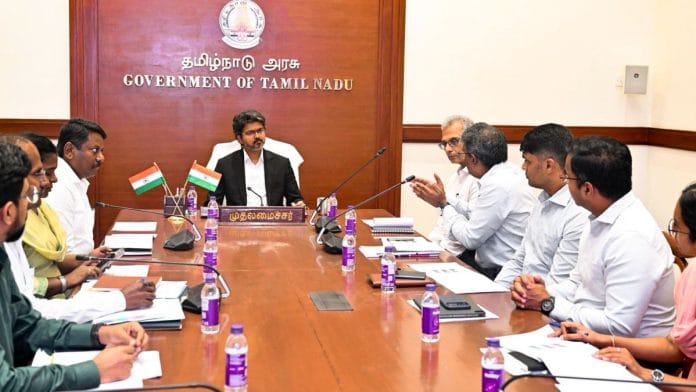
This is why Vijay’s proposed white paper matters. The important question is not ‘How much did Tamil Nadu borrow?’, but ‘What did Tamil Nadu borrow for?’. Debt used to build infrastructure, improve education and attract investment can strengthen the economy. Debt used only to finance recurring giveaways cannot.
A state whose finances are genuinely in freefall does not typically produce numbers such as 10 per cent real growth. So based on the current assumption of a cautious economic situation, the white paper should ideally explain how a growing economy left the government short on cash rather than only documenting the previous government’s spending record.
The composition of borrowing—such as how much went into capital assets, and how much went into recurring commitments—and what fiscal room exists for TVK’s own campaign commitments, is what is expected in the promised white paper. The latter would be the real test of transparency, because it asks a new government to hold itself to the same standard it is applying to the one it replaced.
Tamil Nadu’s Rs 10 lakh crore debt can’t be labelled a crisis or business as usual yet. The white paper will say which.
Arul Braighta is a research officer at the Chennai Centre for China Studies. Views are personal
(Edited by Theres Sudeep)

